
Judith Keene
Treason on the Airwaves
The chapter entitled “Iva Toguri and the Trial of Tokyo Rose” raises profound questions about the operation of post war justice and particularly the pernicious influence of the Japanese-American community in turning a collective back to Iva and her mistreatment and trial.
By contrast, the heroes of the courtroom were the three defense lawyers. All waived their fees. They were led by Wayne Collins, the founder of The American Civil Liberties Union in Northern California and a tireless advocate for the rights of Japanese internees.
Toguri’s defense trio faced the large and well-funded government prosecution team. That included two assistant attorney generals, two extra lawyers, and a back up of designated FBI agents. Plus, J. Edgar Hoover had sent out a general call across the FBI that agents should collect whatever incriminating material they could dredge up on Toguri and her family. In addition, the prosecution brought at least twenty witnesses from Japan to testify against her.
The penurious defense, by contrast, was denied any court support to bring witnesses. But even so, Collins and his associates, with great skill, were able to show the flaws in seven of the eight treason charges raised.
The other notable feature of the trial was the absence of any community voices for Iva from Japanese Americans. Her father came to court every day, but there was nobody else. The members of the Japanese-American community studiously ignored Toguri and her trial. Or, even worse, berated her as a traitor who had brought disrepute on all Japanese Americans.
Certainly, for them, the immediate post war years were difficult. At the time, leaders of community groups, like the Japanese American Citizens League (JACL), were bent on raising American awareness of the hardships the internees had suffered and their consequent entitlement to compensation. These claims were carefully framed as matters of American justice for Americans of Japanese descent. JACL leaders and the editors of local Japanese-American newspapers consciously avoided the thorny matter of Japanese brutality towards prisoners in the Pacific War in favor of the new discourse that propounded, quite correctly, the suffering of Japanese Americans as victims of racism in America.
Toguri’s figure and her trial suggested the contradictions in both positions.
Twenty-five years later, the JACL formally apologized to Iva Toguri for their reprehensible behavior at the time of her trial, and the mean-spiritedness they had shown towards her in the subsequent years.
In their variegated contexts, racism was the catalyzing factor in each of these micro-histories. John Amery and his anti-Semitic confreres understood so little about human existence that they imagined that Jews were the source of the world’s problems. Iva Toguri and her generation of Japanese Americans were excluded from full acceptance in their own place of birth on the West Coast but were never at home in Japan. Many Australians and Americans of Charles Cousens’s generation accepted with equanimity that the price of ending the Pacific War was that the citizens of Hiroshima and Nagasaki should be turned to ash.
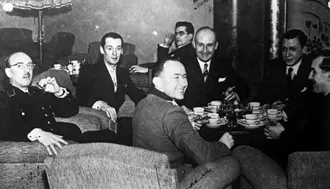
John Amery taking tea with German officers and Flemish Nazis, Antwerp April 1944. (Image courtesy of The United Kingdom Public Record Office, Kew.)
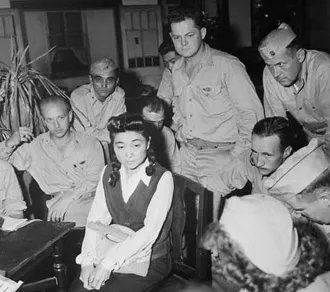
Iva Toguri faces the American press corps in Yokohama in September 1945. (Image courtesy of the US National Archives and Records Administration, San Bruno.)
Editor: Erind Pajo
Treason on the Airwaves
Judith Keene Treason on the Airwaves: Three Allied Broadcasters on Axis Radio During World War Two Bison Books 228 pages, 6 x 9 inches ISBN: 978 0803232921
Available here →May 2, 2011
20110502-keene-judith-treason-airwaves-allied-broadcasters-axis-radio-world-3
A close-up
The rest of this thread

Judith Keene
Judith Keene is an Associate Professor in the History Department at the University of Sydney, where she teaches and writes about war and culture and film and history. She is currently writing a cultural history of memory and the Korean War.
Pull this thread
Postwar treason verdicts followed popular emotion and politics, not conduct, which is why Iva Toguri alone was charged.
Know something the rest of us don't?
Most threads on Rorotoko begin with our invitation. Any thread can begin with a proposal: you write it with the same prompts every thread answers, and we review it.
Propose a thread →