
Nicholas Dungan
Gallatin
I wrote this book for the reader—I wanted the reader to be able to participate in a good story, and for Albert Gallatin to come alive in the pages.
But I was also aware that reading a book—even a book as short, as concise as this one—is a journey that different travelers, different readers, take at their own pace and in their own fashion.
So the Introduction is a roadmap—and yet one with room for surprises and unexpected detours... You can start the book at the beginning of chapter one and not get lost—but if you read the Introduction, you will feel quite sure of where you are throughout the rest of the book.
I begin the Introduction with an abbreviated life of Albert Gallatin, so that you have all the highlights and accomplishments of his life in chronological order, from his birth in Geneva to his death in New York 88 years later—all in less than three pages.
Gallatin’s life and legacy shed a new light on an early America rooted in Europe, an America that was one country among many in a complex world. Only after Gallatin had successfully negotiated the end of the War of 1812 did the United States develop on its own. And by that time the European foundations of the United States had already solidified.
So in the Introduction I lay out the inspiration for this book and examine “The Quandary of Gallatin’s Obscurity”—a haunting question throughout the research and writing.
The Introduction also explains my goal of helping Albert Gallatin’s human story come alive to “a new audience in a new era.” I describe my impressions of who he was, with his strengths and weaknesses, qualities and limitations, successes and failures.
The Introduction ends with a glimpse of the architecture of the book. The nine chapters, organized in three parts, follow Gallatin’s rise, his achievements at the pinnacle of power, and his role as a senior statesmen. But, in a fortuitous pattern, within each of the three parts, there is a similar sequence: he progresses, then has to overcome difficulties, then progresses still further. He does that all three times!
And even covering all this, the Introduction is only six pages long.
I will hope that, on both sides of the Atlantic, Gallatin: America’s Swiss Founding Father may serve, at many different levels, to strengthen the sense of shared heritage and shared destiny between the United States and Europe.
My book will prove to have lasting value if it causes the American readers to understand how much they and their country owe to continental Europe. The “Idea that is America” did not appear ex nihilo. The inspiration and the energy that made it possible for the United States to come into being and to succeed thereafter arose from European sources.
One quarter of a millennium after his birth, the Swiss too had largely forgotten Albert Gallatin, and even in Geneva. So I am delighted that my book, and the surrounding Gallatin250 project that I suggested to Swiss diplomacy, have helped revive his memory and increase the focus on his legacy in the land of his birth.
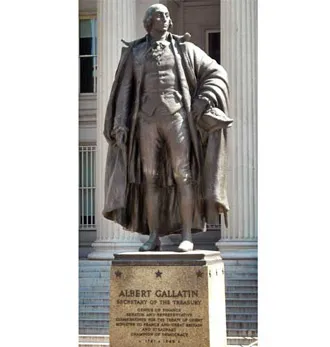
Albert Gallatin, James Earle Frazer, 1947. (AgnosticPreachersKid, Wikimedia Commons.)
Editor: Erind Pajo
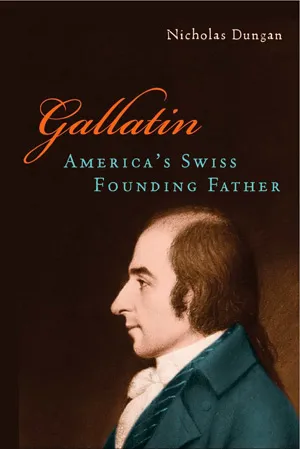
Gallatin
Nicholas Dungan Gallatin: America’s Swiss Founding Father New York University Press 224 pages, 6 x 9 inches ISBN: 978 0814721117 ISBN: 978 0814721124
Available here →May 18, 2011
20110518-dungan-nicholas-on-gallatin-america-swiss-founding-father-3
A close-up
The rest of this thread

Marina Fragoso Senra
Nicholas Dungan
Nicholas Dungan is a writer and independent commentator on international relations, politics and business. He is a Senior Advisor to the Institut de Relations Internationales et Stratégiques in Paris (IRIS). Nicholas Dungan was previously president of the New York-based French-American Foundation from 2005 to 2008. He is a member of the Board of Directors of the Chatham House Foundation, the U.S. arm of the Royal Institute of International Affairs at Chatham House in London, and an Honorary Fellow of the Foreign Policy Association in New York. Prior to joining the French-American Foundation, Nicholas Dungan spent more than twenty years as an international investment banker in New York, London and Paris. He held senior positions with several major international firms, notably Merrill Lynch and Société Générale. He is a member of the board of directors of the Sciences Po Alumni USA. He is a graduate of Sciences Po Paris, Stanford University and St. Paul’s School.
Pull this thread
The United States became truly independent in 1815, not 1783.
Know something the rest of us don't?
Most threads on Rorotoko begin with our invitation. Any thread can begin with a proposal: you write it with the same prompts every thread answers, and we review it.
Propose a thread →