
Matthew E. Kahn
Climatopolis
To tackle climate change, we must reduce our greenhouse gas emissions. In an economy in which there are more people who are growing richer over time, the only way we can reduce our emissions is if greenhouse gas emissions per dollar of economic output fall sharply.
For this we will need technological progress; we will need to phase out fossil fuels such as coal, gasoline and natural gas, and replace them with renewable power.
Such progress will require all consumers to face higher prices for “cheap” fossil fuels—and this requires government intervention.
Should we raise gas taxes and more generally fossil fuel prices to accelerate the transition to the green economy? Many environmentalists—including myself—would favor this.
I believe that there are significant social costs associated with the status quo reliance on fossil fuels. And I am optimistic that clever entrepreneurs will respond to pricing incentives. They will make technological progress in bringing electric vehicles and solar panels to the market place. Such “green innovation” would allow us to achieve the win-win of ongoing economic growth without the local pollution and greenhouse gas emissions consequences.
But President Obama has risked no political capital pursuing such policies. Indeed, in the midst of ongoing recession, would “Joe the Plumber” re-elect a president who raised energy prices through government policy?
Recognizing the political challenge in changing the rules of the game and raising the cost of fossil fuel energy, Democrats have tried alternative strategies for increasing voter interest in carbon mitigation policies.
Al Gore’s movie, An Inconvenient Truth, can be viewed as a variant on the “Shock and Awe” strategy of changing perceptions through offering a vision of how our future might look like if we continue to produce increasing quantities of greenhouse gas emissions.
Perhaps in part due to Al Gore’s efforts, climate change mitigation is a partisan issue rather than a national security issue.
Today, there is a sharp political cleavage between the political left and right. Survey research documents that in 2008 there was 34 percentage point gap between Democrats and Republicans in their agreement with a statement that the effects of global warming have already begun, up from a 4 percentage point gap in 1997. And I see no signs that this political gridlock will go away.
I wrote Climatopolis because I wanted to start a debate on how individuals and firms respond to a growing “crisis” when their government has been unable to pre-empt the emerging threat.
I do not have a crystal ball that tells me what Moscow, Cairo or Los Angeles will look like in the year 2050. But I do know that free market capitalism is centered in cities and their greater metropolitan areas.
I anticipate that over time we will learn about the specific new threats that specific cities face.
Cities that face increased flooding risk will create new profit opportunities for firms that produce products that help to reduce flood risk. If such cities’ political leaders choose to address these emerging threat issues, then local land prices will not decline, and the skilled will continue to live there. If politicians are unwilling or unable to protect the cities, then the skilled will “vote with their feet,” and the firms that hire them will also leave. In this sense, competition between cities protects urbanites.
Over time, we must rebuild our cities. As the world’s cities grow with billions of people moving there, there will be new construction of plenty of infrastructure. Given that cities are long lasting investments, decision makers have the right incentives to invest and to build infrastructure that can withstand the shocks that we believe we will face due to climate change.
A maintained assumption in Climatopolis is that our climate scientists will continue to make objective progress in judging the probability and severity of the impacts of climate change for different regions around the world.
If I am wrong and our climate scientists make no progress in predicting threats—while Mother Nature poses a higher probability threat of extreme events such as flooding or extreme heat waves—then we will suffer greatly when the shocks occur.
But if climate scientists do earn their pay and we are able to develop coarse “leading indicators” about the threats we face—the equivalent of a Tsunami Warning—then I trust that individuals and firms have the right incentives to respond to this information.
After the deep Recession of 2008, it is not “cool” to celebrate free market capitalism. My book intentionally challenges this social norm.
You do not have to be a billionaire to appreciate how free market growth has improved the quality of life for billions of people around the world. Climate change will be a major threat to our quality of life in the next century. And capitalism will again step up to help us to cope with the anticipated and unanticipated challenges we will face.
Editor: Erind Pajo
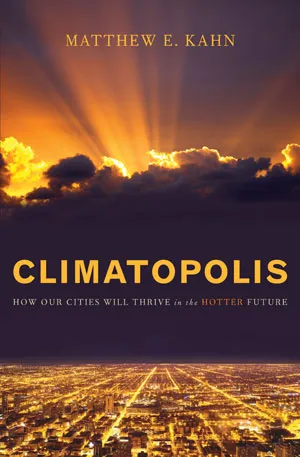
Climatopolis
Matthew E. Kahn Climatopolis: How Our Cities Will Thrive in the Hotter Future Basic Books 288 pages, 6 x 8 1/2 inches ISBN- 978 0465019267
Available here →May 25, 2011
20110525-kahn-matthew-climatopolis-how-our-cities-will-thrive-hotter-future-3
A close-up
The rest of this thread
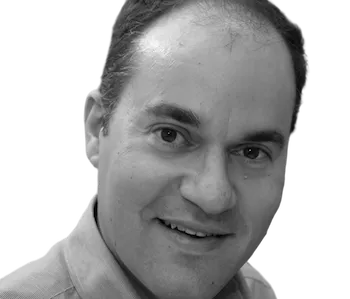
Matthew E. Kahn
Matthew E. Kahn is a Professor at the UCLA Institute of the Environment, the Department of Economics, the Department of Public Policy, and the Anderson School of Business. He is a research associate at the National Bureau of Economic Research. Before joining the UCLA faculty, Kahn taught at Columbia and the Fletcher School at Tufts, and also served as a Visiting Professor at Harvard and Stanford. He holds a Ph.D. in Economics from the University of Chicago. Kahn is the author of Green Cities: Urban Growth and the Environment (Brookings Institution, 2006), co-author of Heroes and Cowards: The Social Face of War (Princeton 2009), and Climatopolis, featured in his Rorotoko interview.
Pull this thread
The free-market growth that caused climate change is also what will let households and firms adapt to it.
Know something the rest of us don't?
Most threads on Rorotoko begin with our invitation. Any thread can begin with a proposal: you write it with the same prompts every thread answers, and we review it.
Propose a thread →