
Ian Goldin
Exceptional People
This book addresses a wide range of readers, and does not require any prior knowledge of the subject. But, even for specialist readers, the book contains enough which is new.
Exceptional People is unique in covering both historical and forward-looking perspectives from a range of disciplinary insights and from the perspectives of receiving countries, sending countries, and the migrants themselves.
Readers most concerned with the impact on the receiving countries will be interested in the examination of whether migrants cost societies more than they benefit, how they influence local wages and employment, and how the tax they pay relates to the benefits they receive.
There is fascinating new data which shows the remarkable contributions of migrants to start-ups, innovation and the dynamism of societies. The recently emerging data on the disproportionate contribution of migrants to new areas of economic growth surprised me—and I imagine it will surprise readers too.
For readers most concerned with the implications of migration for sending countries, the sections of the book which deal with the brain drain, remittances, domestic investment and the social and political costs of migration will be of interest. I have found that much of the literature on this fails to give a balanced view of the tremendous contribution made by people who have left their homes.
The book seeks to explain why individuals migrate and highlights that this decision is in fact usually taken in conjunction with families and even communities, and is highly related to the experience of friends and networks. The development of “migration chains” helps explain the high geographic concentration of migrants from certain sources with their destinations, as does the dispersal of these networks over time.
Policy makers and concerned citizens may be particularly interested in the third part of the book which is devoted to the likely future evolution of demographics and labor markets as well as the possible impact of environmental, climate, conflict and other potential drivers of migration.
The concluding chapter focuses on the global migration agenda. After highlighting the extent to which migration is the neglected orphan of the international system, this chapter offers suggestions as to what should be done.
Migrants are exceptional people because they make difficult choices and sacrifices in order to secure a better life for their communities, families and themselves. They play an exceptional role in the societies they enter. Too often they are regarded as “others,” not part of the host society.
Current policies are too often counterproductive. A more effective and humane migration regime is urgently needed. Such regime needs to recognize not only that we all can trace our heritage and achievements to migration, but also that migrants produce enormous benefits and are the source of our future prosperity.
Editor: Erind Pajo
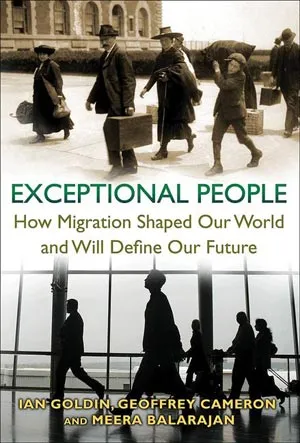
Exceptional People
Ian Goldin Exceptional People: How Migration Shaped Our World and Will Define Our Future Princeton University Press 352 pages, 6 x 9 inches ISBN 978 0691145723
Available here →June 1, 2011
20110601-goldin-ian-exceptional-people-how-migration-shaped-world-future-3
A close-up
The rest of this thread

Ian Goldin
Ian Goldin is the Director of Oxford University’s Martin School and a Professorial Fellow at Balliol College. He has served as Vice President at the World Bank, Chief Executive at the Development Bank of Southern Africa, advisor to President Mandela, Principal Economist at the European Bank for Reconstruction and Development, and Principal Economist at the OECD Development Centre. Among numerous awards and prizes, he has been knighted (Chevalier) by France, and nominated Global Leader of Tomorrow by the World Economic Forum. Ian Goldin has published over fifty articles and thirteen books, including The Economics of Sustainable Development, Globalization for Development, and Exceptional People, featured in his Rorotoko interview.
Pull this thread
Migration is the engine of human progress, and today's restriction is the historical anomaly, not the openness it replaced.
Know something the rest of us don't?
Most threads on Rorotoko begin with our invitation. Any thread can begin with a proposal: you write it with the same prompts every thread answers, and we review it.
Propose a thread →