
Rachel Weiss
To and from Utopia in the New Cuban Art
My own engagement with Cuban art began in 1985, the result of a happy accident. I was immediately fascinated by the work that my peers in Havana were making: it was incredibly rich and diverse in aesthetic terms, and there was a social energy around it that I had never experienced in other artworks.
This was a time when “political art” in the US was largely sloganeering and directed against government policies (e.g., the wars in Central America), and what was happening in Cuba felt much more oxygenated and much less narrowly construed—political in its engagement with real and shared political space, rather than with the ideological surfaces of institutional power.
The “utopia” of the title points in a couple of directions: the dream of a just and equitable society, and that of an artistic practice that has full partnership in that project, without conceding its unique expressive, intellectual and idiosyncratic foundations.
To and from Utopia in the New Cuban Art deals with a pretty broad range of questions in contemporary art, especially ones having to do with the edges at which art intersects with the social and political fabric.
The book is about an artistic movement that, in the space of a couple of decades, developed extraordinary momentum as an occasion and catalyst for public debate in Cuban society, and which—with equal rapidity, not to mention paradox—became a poster child for political commitment in the global art market.
The book traces these developments, looking closely at the works and the circumstances under which they were produced. I also zoom out into the broader context, looking at the ways that Cuban state policies impacted cultural production on the island and its circulation internationally: this includes sections on how this “new Cuban art” was neutralized into a mere formal innovation by the national museum, alongside the parallel martyrological narrative that plays out in the Museum of the Revolution.
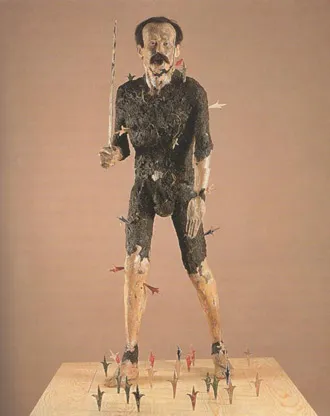
Juan Francisco Elso, “Por América,” (1986). (Photo: Gerardo Suter.)
Editor: Erind Pajo
To and from Utopia in the New Cuban Art
Rachel Weiss To and from Utopia in the New Cuban Art University of Minnesota Press 368 pages, 8 x 10 inches ISBN 978 0816665143 ISBN 978 0816665150
Available here →July 4, 2011
20110704-weiss-rachel-to-and-from-utopia-in-the-new-cuban-art-2
The wide angle
The rest of this thread

Rachel Weiss
Rachel Weiss has curated exhibitions and written books including “Global Conceptualism: Points of Origin 1950s-1980s,” Making Art Global: The Third Havana Biennial 1989 (forthcoming from Afterall Books), and To and from Utopia in the New Cuban Art, featured in her Rorotoko interview. She is currently working on a series of essays about artworks that either do or else try to cross ethical boundaries and put their viewers into questionable situations. Weiss teaches in the Art History and Arts Administration and Policy departments at the School of the Art Institute of Chicago.
Pull this thread
The chastened Cuban art of the 1990s asked how a people lives with disenchantment after building the sky.
Know something the rest of us don't?
Most threads on Rorotoko begin with our invitation. Any thread can begin with a proposal: you write it with the same prompts every thread answers, and we review it.
Propose a thread →