
Mark Lynn Anderson
Twilight of the Idols
For me, the key chapter of Twilight is the short chapter on Nathan Leopold and Richard Loeb.
Many people today have only the vaguest notion of the these two young men who, in the summer of 1924, were sentenced to life plus ninety-nine years for the kidnapping and murder of a fourteen-year-old boy who lived in their wealthy Chicago neighborhood.
Three motion pictures have recounted their case from varying perspectives: Alfred Hitchcock’s Rope (1948), Richard Fleischer’s Compulsion (1959) and Tom Kalin’s Swoon (1992).
But the newspaper coverage of the trial of Leopold and Loeb was a self-reflexive demonstration of how the new media situation created by Hollywood’s celebrity culture might involve a mass audience in a process of producing the very terms by which health and disease were to be understood in the modern era.
Because Leopold and Loeb pled guilty and avoided a jury trial, their team of lawyers were allowed to provide evidence that these two young men, while unusually gifted with intelligence and social charms, had committed this crime out of a compulsion that could only be comprehended by considering the myriad circumstances of their respective lives and their unique relationship.
Thus the trial was devoted to hearing testimony from psychologists and alienist who detailed the two young men’s biographies, their fantasies, and their worldviews. Because of the sustained and extensive attention given to the details of their private lives, Leopold and Loeb quickly achieved the status of celebrities. While the defendants never took the stand, they were constantly interviewed by the press during the trial and were photographed in and out of the courtroom, usually depicted as deeply interested in themselves, their trial, and the public that paid attention to them.
In many ways, Leopold and Loeb were continually shown to be consuming themselves as media images, with Loeb “confessing” at one point that he didn’t mind spending the rest of his life in prison if he could only have a scrapbook containing all the newspaper accounts of his trial. This media coverage brought people together, but not as a sham jury waiting to mete out some form of populist justice through public opinion. Instead, the publicity generated by the trial allowed a mass public to take an active interest in the psychological and social processes of personality formation while simultaneously understanding and expressing their own relations to deviance.
The possibilities implied by the non-directed reception of the star criminals in 1924 had to be contained by closely regulating the representation of the trial’s audiences, making either incoherent or pathological any appeal the killers might have held for the public.
In other words, public opinion had to be constructed. Yet, even today, the smallest details of the case are capable of producing a powerful fascination, though now such fascination is usually followed by a sense of corrective guilt, a guilt that continually seeks to become collective.
I wrote Twilight out of a love for late silent cinema, but the book has little to do with cinephilia or with the films themselves.
I am more concerned with the sort of audiences that the Hollywood films of the era imply and, more broadly, with the sort of society that made the late silent cinema in America possible.
While I hope that my book might add in some small way to the growing number of works that take seriously the interrelations between culture and the history of science, my greater wish is that Twilight makes it more difficult for media scholars to assume the innocence or simplicity of earlier audiences of the mass media.
Schooled in post-structuralism and postmodernism, we like to pride ourselves on having sophisticated notions about identity. We find it fairly unimaginable that large sectors of the public prior to, say, the Second World War were capable of conceiving of identity as relational, of having a nuanced understanding of the unconscious, or of thinking race, gender, and sexuality to be amenable to personal, social, and historical transformations. To the extent that such sophistication is cherished by us as properly the domain of social scientists, media experts, and cultural critics, I want readers of Twilight of the Idols to question at what cost such professionalization was won and at what costs it continues to be maintained.
Yet, and this is perhaps my own delusion, I wrote this book out of respect for and in solidarity with the perverts of the past.
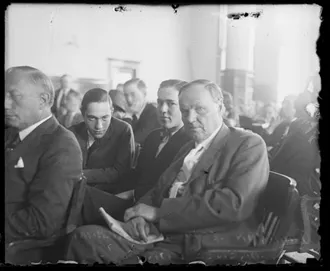
A new mode of stardom. Nathan Leopold, Richard Loeb, and their chief defense attorney, Clarence Darrow, in 1924. Chicago Daily News press photograph courtesy of Chicago Historical Society.
Editor: Erind Pajo
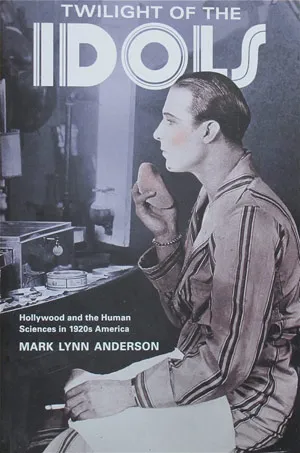
Twilight of the Idols
Mark Lynn Anderson Twilight of the Idols: Hollywood and the Human Sciences in 1920s America University of California Press 238 pages, 6 x 9 inches ISBN 978 0520237117 ISBN 978 0520267084
Available here →August 15, 2011
20110815-anderson-mark-lynn-twilight-idols-hollywood-human-sciences-1920s-3
A close-up
The rest of this thread

Recent photograph
Mark Lynn Anderson
Mark Lynn Anderson is Associate Professor of Film Studies in the Department of English at the University of Pittsburgh. He has published numerous articles and book chapters on film historiography, early film education, the star system, and film censorship. His current research is on early historical accounts of the American studio system written during the period 1915 to 1935.
Pull this thread
Audiences following 1920s Hollywood star scandals helped found the human sciences that later claimed personality as their own.
Know something the rest of us don't?
Most threads on Rorotoko begin with our invitation. Any thread can begin with a proposal: you write it with the same prompts every thread answers, and we review it.
Propose a thread →