
Keith Roberts
The Origins of Business, Money, and Markets
Each chapter deals with similar questions. What were the main forces that shaped business and its role in the economy? What new businesses emerged? How did they operate? What was the nature of business labor? How were business people regarded? In short: What was new about business, and why?
My concept of the key forces that shaped business includes both impersonal forces like climate, geography, and technology, and the contributions of extraordinary individuals. Given the times, they were almost all men: kings called “the great,” such as Sargon, Cyrus, and Darius in the Middle East, and of course Alexander of Macedon; thinkers like Solon, Aristotle, and Archimedes; Roman emperors including Augustus, Diocletian and Constantine.
We also encounter such businessmen as the trader Imdi-Ilum of 2000 BC Assur, the banker Balmonahse of Babylonia, Roman investors like Pliny the Younger and Cato the Elder, and the greatest ancient tycoon of all, Marcus Crassus. All these people inhabited a world full of murder, cruelty, villainy and perversion, as well as love, wisdom, courage and heroism—and so, therefore, does the story. You ask how my professional path led to this book. Others have asked how long it took me to write, and I usually answer “all my life.”
I was the lucky recipient of a wonderful liberal arts education, in the course of which my chief passion was the law.
But shortly after graduating from law school I happened into one entrepreneurial role after another, ultimately managing or participating in a broad variety of small businesses: law firm management, investment advisory services, real estate development, magazine publishing, cosmetic and toilet goods marketing and distribution, and contract manufacturing. Along the way I was an avid business school student and reader of business journals, and took many independent courses in management.
It was while trying to modernize the management and operation of my manufacturing company that the idea leading to this book first emerged. Late one evening I was stomping around my office, talking to myself in frustration about poor management, when I heard myself say “This company is run like a Roman blacksmith shop!”
And that stopped me. I realized that I had no idea how Roman blacksmiths operated—or even whether they existed in ancient Rome.
I got curious about how business first began, and tried to find a book on the subject. Finding none, I started reading business history. Pretty soon I realized that there was an important not to mention interesting story here. And nobody had ever told it.
Editor: Erind Pajo
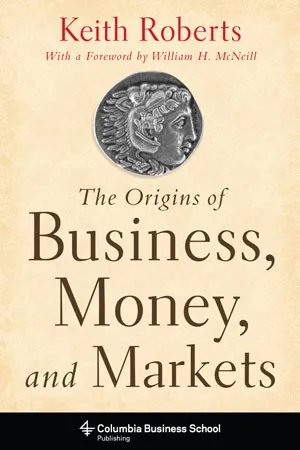
The Origins of Business, Money, and Markets
Keith Roberts The Origins of Business, Money, and Markets Columbia University Press 368 pages, 6 x 9 inches ISBN 978 0231153263
Available here →August 17, 2011
20110817-roberts-keith-on-the-origins-business-money-markets-2
The wide angle
The rest of this thread

Keith Roberts
Keith Roberts earned his B.A. at Harvard University and is a graduate of Harvard Law School and the Harvard Business School’s Program in Venture Capital. He has served as president of The Preservation Group, a San Francisco real estate firm, Roberts Proprietaries, Inc., a manufacturing and distribution company, and other firms. He is an arbitrator for the Financial Industries Regulatory Authority and a mediator in the New York court system.
Pull this thread
pulls againstpulls alongside
Business in a form recognizable today was born in the Greek city-states after 600 BC.
Against FB · Capitalism has outlived two centuries of predicted deaths because it is rooted in the hierarchical, individualistic structure of Western societies. On: The past supplies usable guidance for present decisions
Against JS · The judgment of history is a fantasy, and history renders no verdict at all, only a record of contention. On: The past supplies usable guidance for present decisions
Alongside SB · Where to draw the line between gambling and investment is a moral and political question, not a technical one. On: The past supplies usable guidance for present decisions
Alongside CK · Isolationism was the dominant American statecraft from the founding to Pearl Harbor, and it served the nation well. On: The past supplies usable guidance for present decisions
Alongside SN · The belief that without God there is no morality is a dangerous conflation of two separate domains. On: The past supplies usable guidance for present decisions
Alongside KJ · Modern lobbying was invented at Sam Ward's dinner table, trading information and access rather than railroad stock. On: The past supplies usable guidance for present decisions
Nearby PB · Corporate support for Black culture is diversity capital, an asset the firm accumulates for itself.
Nearby YC · Financial crises have rarely been the forces for reshaping finance we want them to be.
Know something the rest of us don't?
Most threads on Rorotoko begin with our invitation. Any thread can begin with a proposal: you write it with the same prompts every thread answers, and we read it.
Propose a thread →