
Thuy Linh Nguyen Tu
The Beautiful Generation
The fun thing about writing a book about an emerging phenomenon is that there is always something surprising to learn.If I could direct readers to any part of the book, it would be to those sections in chapter 2 when I talk about how Asian American designers and Asian sewers talk to each other, using the language of kin—calling them uncles and aunties—and how they imagine their relationship to each other.
Those exchanges were very surprising to me because they seem to undo a lot about what we think we know about sewers and the craft of sewing—as low-wage, disempowered, immigrants doing unskilled work. They revealed to me that categories which seem so fixed to us are in practice actually constantly shifting.I often find myself saying that this book is about New York’s fashion industry—but then almost immediately thinking that it’s really not about the fashion industry at all.
The book certainly started out that way, and fashion has remained a central object of analysis. But what I discovered in the process of research was that I was actually learning much more about the nature of social connection and affiliation—about how we manage to retain social relationships in the face of forces that continually divide.
One of the ways in which we have been thinking about these questions lately is through discussions of social media. But while such technological developments have allowed us to keep up with old friends from far away and have as such ameliorated the problem of temporal and spatial distance, they have not really resolved the problem of social distance. For even in the midst of all this social networking, we are still seeing each other as inherently disconnected, as red states and blue states, as West and non-West, as us and them.For me this was not a problem of difference only—if fashion teaches us anything it is culture’s ability to domesticate difference and to make it desirable and consumable—it was really a problem of social distance.What excited me about what I witnessed here was the way that people were coming to see each other—across vast differences—as potential allies (potential only).
I was very interested in exploring those moments, and they were often no more than just moments, when people could express to each other a sense of obligation (if not actual responsibility) that exceeded their relationships as producers and consumers, clients and contractors, employers and employees—that was extra-market, even as it rooted in the marketplace.Without such moments of recognition of mutual interdependency, it would be impossible to engage in acts of coalition. And what, really, would be possible in this world without acts of coalition?
Editor: Erind Pajo

The Beautiful Generation
Thuy Linh Nguyen Tu The Beautiful Generation: Asian Americans and The Cultural Economy of Fashion Duke University Press272 pages ISBN 978 0822348900ISBN 978 0822349136
Available here →August 24, 2011
20110824-tu-thuy-on-beautiful-generation-asian-america-culture-economy-fash-3
A close-up
The rest of this thread
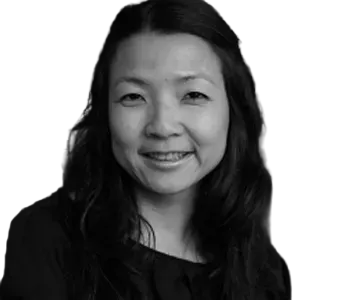
Thuy Linh Nguyen Tu
Thuy Linh Nguyen Tu is Assistant Professor in the Department of Social and Cultural Analysis at New York University, where she teaches in the programs in American Studies, Asian/Pacific/American Studies, and Metropolitan Studies. In addition to authoring The Beautiful Generation, she is also the co-editor of Alien Encounters: Popular Culture in Asian America (Duke) and Technicolor: Race, Technology, and Everyday Life (NYU).
Pull this thread
Asian American designers reached the top of New York fashion because Asian immigrants were already in garment production.
Know something the rest of us don't?
Most threads on Rorotoko begin with our invitation. Any thread can begin with a proposal: you write it with the same prompts every thread answers, and we review it.
Propose a thread →