
Nezar AlSayyad
Cairo
The last chapter of Cairo, the grand finale, if you will, speaks to the necessity of knowing the history of the city in order to understand the present.
In a globalizing era, when cities no longer belong exclusively to their people, the image of the thing will come to replace the thing itself. Without knowing the history of Cairo, one would not be able to see that it is now transforming itself into its imagined historical aesthetic, a sort of Disney-like theme park, where restorations of historical sites will be modeled after their modern-day replicas, rather than the other way around.
That is one possible avenue of change. Another is that Cairo will continue to be an innovative city, one that its citizens will continue to shape through their actions and inactions. Recent events in Cairo suggest the second path.
Not only has this book required me to delve into many histories and different historical methods—it has also forced me to adjust my role as a historian. The choices I have made, in terms of which historical periods to cover (although I try to cover most of the significant ones), which historical characters to single out (again, I try to include all of the noteworthy figures, at least as far as the development of the city is concerned), and in which places to anchor my stories (and here I have had to leave out many), are all part of a broader historical method, rather than just a style of writing.
Writing this book has convinced me that there is no history without historians—with all the biases, frailties, and limitations of their methods. The book also reminds me of an old conviction: history is always written from the present moment, and possibly in the service of it. No history is innocent of contemporary demands. From this perspective, history is neither simply the knowledge of things that have occurred in the past nor the memory of these past events; rather, it is the convergence of these events with certain individuals and in specific places, as discussed and interpreted by others removed from the time and place in which the events occurred.
An underlying assumption behind this work is a fundamental belief that the institutional structure of a society, based on who governs it and how, is often reflected in the places this society produces. Again, this assumption affords methodological limits, because urban form is very complex and cannot be looked upon simply as a language that can just be read. Such reading would be meaningless without the qualifications of social and economic history. At best, the shape of a city becomes a road map for deciphering its history.
Cairo presents a progression of events, through which one can see a pattern. With this historical pattern we can attempt to predict the progression of future events in Cairo. Each event, each change, signals another, just as the events of the years leading up the Arab Spring signaled its arrival. Cairo is a vibrant, alive, and constantly changing metropolis that shapes the lives and imaginations of millions of people.
Under the best possible conditions, the act of writing history consists of piecing together fragments. The process unavoidably leads to resolving contradictions between bits of evidence to arrive at a reasonably substantial version of what has occurred. We inevitably exercise judgment in qualifying which sources are more reliable than others. All these problems are compounded when, as historians, we set out to construct a narrative whose strength lies in its ability to convey precise representations of urban form and space.
But in the final analysis, we must remember that the writing of history will always be, first and foremost, an art of interpretation, not a science of representation. The stories that we depict will change from time to time and from place to place to reflect the interpretations of those who tell them and the interests of the people for whom they are written. The challenge in the telling of history today perhaps lies in reversing the equation and finding the proper balance between what I call the science of interpretation and the art of representation.
In this work, I have attempted to let the multiple histories of Cairo speak for themselves. I am, however, very conscious of how this exercise is enmeshed in a politics of representation in which I play a part. Because I operate mainly in the space between the words and the images, I am perhaps another Baudelairean flâneur who wanders through the city’s history with his mind instead of seeing its actual streets with his eyes.
The great novelist Italo Calvino once wrote that cities are like dreams: their rules seem absurd, their perspectives are often deceitful, and everything in them conceals something else. He tells us that we should take delight not in a city’s wonders, whether these number seven or seventy, but in the answers a city can give to questions we pose, or in the questions it asks us in return. It is only in the context of this wisdom that I have attempted to write this history of Cairo.
Editor: Erind Pajo
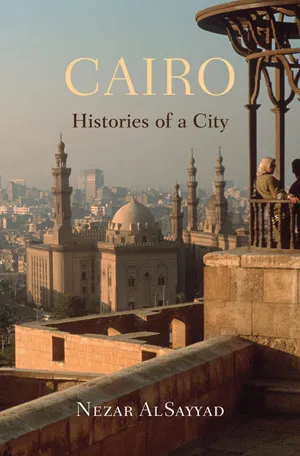
Cairo
Nezar AlSayyad Cairo: Histories of a City Belknap Press of Harvard University Press 352 pages, 6 x 9 inches ISBN 978 0674047860
Available here →August 31, 2011
20110831-nezar-alsayyad-book-interview-cairo-histories-of-a-city-3
A close-up
The rest of this thread

Nezar AlSayyad
Nezar AlSayyad is an architect, planner, urban designer and urban historian. He is a Professor of Architecture, Planning, Urban Design, and Urban History at the University of California at Berkeley. In 1988, AlSayyad co-founded the International Association for the Study of Traditional Environments (IASTE) and he continues to serve as its President. He is also the Editor of the journal Traditional Dwellings and Settlements Review. AlSayyad has authored and edited several books on housing, identity, tradition, urbanism, urban design, urban history, urban informality, tourism and the virtual world.
Pull this thread
Cairo is on course to become a theme-park replica of its own imagined past unless its citizens keep shaping it.
Know something the rest of us don't?
Most threads on Rorotoko begin with our invitation. Any thread can begin with a proposal: you write it with the same prompts every thread answers, and we review it.
Propose a thread →