
Sharon Haar
The City As Campus
Chicago occupies a particular place in the development of American urbanism. Urban reform movements, the city beautiful movement, modern architecture, and urban renewal and public housing were developed and tested in Chicago, often before being transferred nationwide, with both positive and negative results.
The University of Illinois at Chicago campus was built at the same time as the interstate expressways that radiate from the city center. And it was originally called the University of Illinois at Chicago Circle (UICC), for the interchange just to its northeast. When the campus first opened in 1965 it was hailed as “the model for the modern urban university.”
In contrast to the original University of Illinois campus in Urbana-Champaign, with a large green field at its center, the “Circle” campus was designed to teach a lesson about the form of the modern American city, a functionally zoned environment connected by express walkways that hovered above the ground, bringing commuter students to a vast forum and lecture halls at its center.
If the UICC campus was to be a demonstration project for the twentieth century city—a city within a city or a campus as a city—the community it replaced was an example of the neighborhood-based city of the nineteenth century.
The Near West Side, where the campus was built, was also the home of the Hull-House Social Settlement, an institution central to the creation of the progressive city. As a consequence, the choice of location and the battles that ensued from this choice speak as much to the history of urban ideas as the pedagogy for the masses that the architecture housed.
As the campus and its educational programs, student population, and research agendas expanded to meet the demands of the late twentieth and now early twenty-first century, both its architectural and urban forms transformed with them, continuing to tell a story of Chicago urbanism.
The UIC campus, a purpose-built, urban-grant institution, stands in contrast to the emergence of “Loop U,” an assemblage of colleges, universities, schools of art and design, and career academies woven in and around the buildings of the southern end of the city’s historic business district. Here there is no lawn and no center. If UIC was initially designed to be the campus for the inner city and suburban citizen, “Loop U” accommodates the needs of the global city, intermixing art, design, media and IT students with business, law, and culinary institute students. As these institutions revitalize abandoned department stores and outdated office space they also broadcast a new image of the city.
In the end, The City as Campus is concerned with the situation of higher education, how its missions of service, teaching, and research have transformed over time as it has responded locally to its place in an increasingly urbanized, globalized community.
Today the goals of campus design and urban design have begun to merge, often to one another’s benefit. However, as the university proliferates it can create patterns of urban growth that without careful planning and control can be inimical to the character of the cities in which they are situated.
In the book’s conclusion I look at the broader situation of higher education within both physical and virtual space. Bill Readings’s call to understand the scene of teaching as a “network of obligations” can be extended to the relationship between the institution and its host.
Higher education continues to transform in the twenty-first century, discovering new purposes, forms, student populations, and meanings, even as we come to recognize the increasingly non-situatedness of the academic community. If on the one hand, as Arjun Appadurai, Manuel Castells and others note, “ideas and ideologies, people and goods, images and messages, technology and techniques” move in a “space of flows,” at the same time, according to Saskia Sassen, the ability of a city to remain or become central rather than marginalized in this global network requires it to be a site of “production and innovation.”
As American universities expand their global footprint, the way they understand the campus as the embodiment of the institutional mission will become increasingly important.
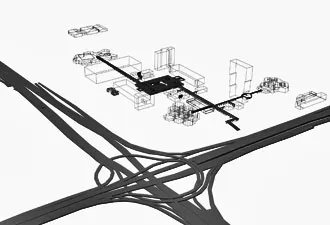
The University of Illinois at Chicago Circle as designed (Cecilia Benites and Sharon Haar).
Editor: Erind Pajo

The City As Campus
Sharon Haar The City As Campus: Urbanism and Higher Education in Chicago University of Minnesota Press 264 pages, 7 x 10 inches ISBN 978 0816665648 hb ISBN 978 0816665655 pb
Available here →October 5, 2011
20111005-haar-sharon-on-city-as-campus-urbanism-higher-education-chicago-3
A close-up
The rest of this thread

Roberta Dupuis-Devlin, UIC Photo Services
Sharon Haar
Sharon Haar is an architect and an associate professor at the University of Illinois at Chicago. She teaches courses and studios in the areas of globalization, housing design, and urban design. In addition to The City As Campus, featured on Rorotoko, she has edited Schools for Cities: Urban Strategies (NEA/ Princeton Architectural Press, 2002) and Dynamic City, a special issue of Nakhara, a new journal on environmental design and planning. Sharon Haar received her Master of Architecture degree from Princeton University and has taught at New York University and the Parsons School of Design.
Pull this thread
The urban campus is a distinct spatial type, not a compromised version of the ideal one.
Know something the rest of us don't?
Most threads on Rorotoko begin with our invitation. Any thread can begin with a proposal: you write it with the same prompts every thread answers, and we review it.
Propose a thread →