
Barbara Will
Unlikely Collaboration
The intense, warm, almost passionate friendship of Gertrude Stein and Bernard Faÿ can be seen in a couple of exchanges during the 1930s. This is a letter Stein wrote to Faÿ in 1933 after hearing him lecture:
“My dear Bernard, When I got home just a little tired I realized fully how moved and passionately interested I had been. It was an extraordinary experience. I was living in you and living in the thing and for once in my life almost not living in myself. A strange and very moving xperience and giving me quite a new point of view toward life…contact with your mind is comforting and stimulating, and nothing is more deeply satisfying to me than that. We do mean a great deal to each other. Always, Gtde”
The style here is more than a little reminiscent of sentimental Victorian exchanges between female friends, a genre that Stein herself experimented with in her early lesbian novella Q.E.D. In her letter to Faÿ, Stein, like a lover, presents herself as a supplicant and pupil to her beloved: it is Faÿ who gives Stein “a new point of view toward life” much like the protagonist toward her lover in Q.E.D.
This dynamic, I argue, also lies at the heart of Stein and Faÿ’s mutual and mutually-reinforcing attraction to reactionary politics. According to James Laughlin, a friend of Stein and Faÿ, the two old friends enjoyed conversing with one another and conversation often veered toward politics:
“An exchange I heard one night troubled me…They got on the subject of Hitler, speaking of him as a great man, one perhaps to be compared with Napoleon. I was stunned. Hitler’s persecution of the Jews was well publicized in France by that time, and Miss Stein was a jew. Faÿ, in his turn, had nearly gotten himself killed fighting the Germans in World War I. I couldn’t forget that strange exchange.”
For Laughlin, it was strange, disconcerting, and altogether unlikely to hear the two friends talk of Hitler’s greatness. But for Stein, at least, conversing with Bernard Faÿ could be a seductive and liberating thing. In a letter from the early 1930s, she writes perhaps her most significant sentence about their friendship:
“and of course I see politics but from one angle which is yours.”
As a literary critic and an historian, I am interested in the way that authors and their works function within and against their times. One of the striking aspects of the early twentieth-century period known as modernism—from Picasso to Pound, from Kandinsky to Stravinsky—is the self-conscious way in which writers and artists were against their age. This lies behind the famous tension between “modernism” (artistic expression) and “modernity” (a socio-cultural historical moment). Yet for too long we have tended to assume that the stance of modernist resistance or rebellion is by definition progressive—adopted in the service of a future-oriented transformation of modernity.
Many modernist artists and writers did see their work as breaking through tradition or norms in order to arrive at something newer/better/as-yet-unrealized. Yet just as many modernist artists and writers hoped that their work would bring back to life a world lost to the depredations of modernity.
My hope with this book is, first, to resituate Stein where I think she belongs—in the latter camp of reactionary modernism. It simplifies her work and falsifies her life to misread both in the service of our own progressive agendas. The dilemmas of her life, and the realities of her actions and convictions, require careful and objective understanding.
This also applies to our understanding of the man who was once known in France as “the unofficial ambassador to the New World,” Bernard Faÿ. That this erudite, cosmopolitan, Americanophile could have turned into a Vichy regime functionary is surprising to this day. Again, the case studies of both Stein and Faÿ test the limits of what we conventionally know and believe about this period in history.
Finally, I have written this book in order to contribute to our larger understanding of the affinities and disparities between modernism and fascism.
Editor: Erind Pajo
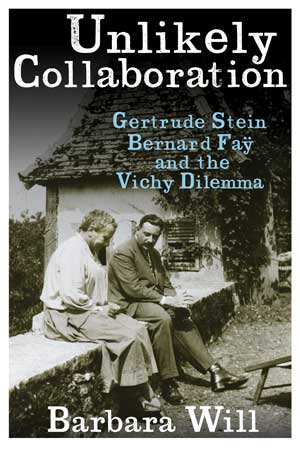
Unlikely Collaboration
Barbara Will Unlikely Collaboration: Gertrude Stein, Bernard Faÿ, and the Vichy Dilemma Columbia University Press320 pages, 6 x 9 inches ISBN 978 0231152624
Available here →October 24, 2011
20111024-will-barbara-on-unlikely-collaboration-gertrude-stein-bernard-fay-vichy-dilemma-3
A close-up
The rest of this thread

Barbara Will
Barbara Will is professor of English at Dartmouth College in Hanover, New Hampshire. She holds a Ph.D. from Duke University, an M.A. from Bryn Mawr College, and a B.A. from Yale University. She is the recipient of fellowships from the American Council of Learned Societies, the National Endowment for the Humanities, the American Philosophical Society, and the Camargo Foundation; and the author of Gertrude Stein, Modernism, and the Problem of “Genius” and Unlikely Collaboration, featured on Rorotoko.
Pull this thread
Radical art has no necessary tie to progressive politics, and Gertrude Stein was a reactionary modernist who supported Pétain.
Know something the rest of us don't?
Most threads on Rorotoko begin with our invitation. Any thread can begin with a proposal: you write it with the same prompts every thread answers, and we review it.
Propose a thread →