
Hal Foster
The First Pop Age
I would be happy for the reader to land anywhere in the book; it is written to engage him or her at any point.
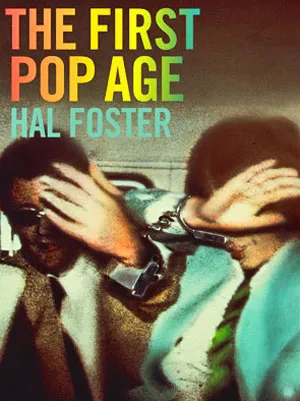
But any reader might as well begin with the cover. Mine shows a detail of painting by Hamilton called Swingeing London 67 (1968) based on a news photograph of a drug bust involving the Rolling Stone Mick Jagger and the art dealer Robert Frazer. Hamilton made no less than seven silkscreened paintings on the subject, heightening its effects in different ways: the grainy image is blurred, the lurid colors are blanched as though by a sudden flash of cameras, and in all but one version the window frame is removed so that we seem to be thrust into the van by the sheer avidity of our own look.
As if in reaction, the two celebrities, who otherwise thrive on such visibility, attempt to deflect it, lifting their hands, manacled together, to hide their faces and to ward away our gaze. The title plays on the hip partygoers (the phrase “Swinging London” was a recent coinage) as well as the severe judgment passed on Fraser in particular (“there are times when a swingeing sentence can act as a deterrent,” the judge intoned, dispatching the art dealer to six months of hard labor), but the image is less a protest against retributive justice than a reflection on the vicissitudes of celebrity. Yet, typically, Hamilton injects an ambiguity here, for Jagger seems to smile, even to smirk, under his palm, and the handcuffs double as bracelets displayed for the benefit of press photographers (in the cover version of the painting they are built up in globs of shiny aluminum). In fact, like other Pop artists, Hamilton is concerned less with the event than with its mediation—how it is produced for us precisely as an image—and it is this mediation that he both exposes and elaborates. For Swingeing London 67 is an early reflection on a media world that has become second nature to us today, one in which transgression and adoration are hardly opposed, manacles are often forged into bling, and sheer visibility, desired or not, trumps everything else.
Let me pick out just two implications of The First Pop Age.
There is a proposition in Pop art, I believe, one that possesses its own psychoanalytical insight, and it is this: if the ego can be understood in part as an image, then the image might be seen in part as an ego, that is, as a surface or screen for psychological projections.
Often in Pop, especially as practiced by Warhol, people are regarded as a species of image and vice versa, with both people and images thus subject to the vicissitudes of the imaginary (which, in the psychoanalytical account, is a volatile realm where narcissistic impulses vie with aggressive ones).
This view of a vexed relation between subject and image in Pop goes against the usual association of this art with the easy iconicity of media celebrities and brand products.
On the contrary, Pop in general and Warhol in particular sometimes underscore the sheer difficulty of our status as homo imago, the great strain of achieving and sustaining coherent images of self and other at all. This strain speaks to a telling doubleness that often obtains in Pop paintings and personae alike, an oscillation between the iconic and its opposite—the evanescent, even the ghostly. So it is, for example, that Warhol could operate as both superstar and specter in art and life alike, or that, despite his emphatic style, Lichtenstein could present the self in Self-Portrait (1978) as an absence, an empty t-shirt topped by a blank mirror.
Yet if these artists are tested, so are they testing.
They test not only the tableau tradition, and its criteria for pictorial composition and its ends of subjective composure, but also popular culture, and its refashioning of the postwar subject as homo imago with a new cultural literacy to learn, even a new symbolic order to negotiate. There is an intrinsic strain in the subject understood as an image (and vice versa), and my Pop artists pressure these vexed relations further. They are concerned, too, to explore the training-and-testing of the postwar subject by different technologies—photographic, cinematic, televisual, and other.
In doing so they also reflect on a test society on the rise—from the military-entertainment complex already parodied by Lichtenstein to the neoliberal factory at large weirdly anticipated by Warhol. Perhaps the last word about painting and subjectivity in the first Pop Age should be his, from a book published just two years before his death, America (1985): “I always thought I’d like my own tombstone to be blank. No epitaph, and no name. Well, actually, I’d like it to say ‘figment’.”
Editor: Erind Pajo
The First Pop Age
Hal Foster The First Pop Age: Painting and Subjectivity in the Art of Hamilton, Lichtenstein, Warhol, Richter, and Ruscha Princeton University Press 352 pages, 6 1/4 x 8 3/4 inches ISBN 978 0691151380
Available here →November 21, 2011
20111121-foster-hal-on-first-pop-age-painting-subjectivity-3
A close-up
The rest of this thread
Hal Foster
Hal Foster is Townsend Martin ’17 Professor of Art & Archaeology & Professor of Architecture at Princeton. Recent books include The Art-Architecture Complex (2011); Art Since 1900 (2005), a co-authored textbook on 20th-century art; Prosthetic Gods (2004), concerning the relation between modernism and psychoanalysis; and Design and Crime (2002), on problems in contemporary art, architecture, and design. A member of the American Academy of Arts and Sciences, Foster won the Clark Prize for Excellence in Arts Writing in 2010. He continues to write regularly for October, which he co-edits; Artforum; and The London Review of Books.
Pull this thread
Pop art is the last chapter of Baudelaire's painting of modern life, not a break with it.
Know something the rest of us don't?
Most threads on Rorotoko begin with our invitation. Any thread can begin with a proposal: you write it with the same prompts every thread answers, and we review it.
Propose a thread →