
David W. Bates
States of War
I think that the reader interested in the pressing contemporary problem of emergency power and its excesses would find the introductory chapter most interesting. There I identify the longer history of the problem and introduce the main conceptual difficulties surrounding the nature of the “political” as an autonomous sphere. For example, I discuss the influential (if controversial) German thinker Carl Schmitt and his ideas about the political as a life-or-death decision about the “enemy.” My use of the term “concept of the political” comes from Schmitt, however I am arguing that Enlightenment thinkers were the first to isolate the autonomous, existential nature of the political sphere. I also sketch out the importance of the Enlightenment for understanding the tensions between legal notions of the state and sovereign conceptions—for it was in the eighteenth century that this conflict first appeared with the first modern notions of constitutional definitions of state authority.
However, I expect that many readers will gravitate to one or more of the individual chapters, depending on their own interests. For example, for those intrigued by the constitutional ideas of Montesquieu, I give a rather iconoclastic reading of his famous depiction of the English constitution, so often taken (even by the founders) as a celebration of the ideal “separation of powers.” For those interested in Locke’s defense of individual rights and property, the chapter on his work will hopefully raise some new questions about the importance of war and enmity that have been overlooked. I focus not only on his theory of prerogative (a kind of emergency power) but also Locke’s analysis of early tribal leadership and his precise definitions of the nature of war. The chapter on Rousseau offers an original take on this author, first by looking at his political theory from the perspective of war and violence, and then by framing his discussion of the political body at war with the crucial metaphors of the nervous system, metaphors that resonate with later ideas of cybernetics.
The book argues that it is the very specificity of a defined political community defending itself in a world of war and violence that alone can sustain rights—and therefore, it is the existential, militarized state that paradoxically guarantees the very possibility of equality, the rule of law, and political freedom. However, this is only possible if we recognize that only authentic political decisions about survival are legitimate ones.
One implication of my argument concerns the way we think about rights today, and especially human rights. Many critical theorists claim that sovereignty and political authority is necessarily exclusionary and therefore anti-democratic. The so-called universal rights of man and citizen (to cite the declaration of the French Revolution) are only given (and protected) within bounded territorial states. Other critics point out that these seemingly universal rights are actually very historically and culturally specific—namely, European and liberal. So what is the nature of a universal “human” right?
I am suggesting that we think about human rights as inherently political. The key argument of the Enlightenment was that rights are derived from a political community that seeks to defend all citizens equally, with no exception. However, there was nothing within that theorization that implied that the only true political community was the nation-state formation prevalent at the time. By thinking of the political as a concept (defining, that is, a certain form of being and activity) we could, I think, begin to think about larger political units, transnational spaces, as defending populations against certain kinds of violence and oppression. This is an open question, and a controversial one. Still, I think that is best to acknowledge the specific kinds of rights we are willing to defend in our historical moment than to assume these are truly “universal” and transhistorical. Otherwise, we risk dehumanizing those that think differently about human order.
Since human rights regimes already depend on military and political support for their implementation, it is important to acknowledge the deeper connections between violence, warfare, and the foundations of rights, if we are to be successful in establishing meaningful protection.
Editor: Erind Pajo
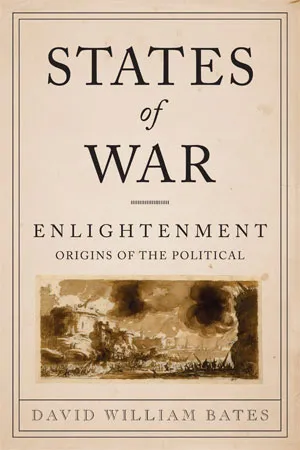
States of War
David William Bates States of War: Enlightenment Origins of the Political Columbia University Press 280 pages, 6 x 9 inches ISBN 978 0231158053
Available here →December 29, 2011
20111229-bates-david-on-states-of-war-3
A close-up
The rest of this thread

David W. Bates
David W. Bates is Professor of Rhetoric, and the current Director of the Berkeley Center for New Media, at the University of California, where he teaches Modern European Intellectual History. Besides States of War, featured on Rorotoko, Bates is the author of Enlightenment Aberrations: Error and Revolution in France (Cornell, 2002) and numerous essays. He is now at work on a new book that traces the intersections between scientific thought, machines, and media technology to investigate the nature of creative human thinking.
Pull this thread
The militarized existential state is the only ground on which equality, liberty and the rule of law can stand.
Know something the rest of us don't?
Most threads on Rorotoko begin with our invitation. Any thread can begin with a proposal: you write it with the same prompts every thread answers, and we review it.
Propose a thread →