
David Scheffer
All the Missing Souls
Pages 2 through 5 state what the book is about, its objectives, the historical significance of the story, and my role in it. Allow me to stitch together some of the key passages here: The futile slogan of “never again” after World War II collapsed under the weight of atrocity crimes occurring again and again…. The task was not to construct a new legal order of perfect justice where every war criminal from the top leaders on down to the foot soldiers would be prosecuted.
Rather, the challenge centered on building tribunals that would hold political and military leaders to account for the atrocity crimes unleashed on innocent civilian populations for which they were primarily responsible.... [W]hat follows is a historical narrative of how international justice evolved exponentially during the decade of the 1990s and into the twenty-first century and brought to an end the presumption of impunity for atrocity crimes. It is the story of the political decisions that shaped the tug-of-war between peace and justice during that dynamic period in world history.In the pages 264 to 266 I describe my days on the Kosovo-Macedonian border in April 1999, as thousands of Kosovar-Albanians fled Serb terror and crowded into fields of utter misery and despair.
I also recount in these pages what I wrote in my notes immediately thereafter—that raw reaction, without any refinement of the clearance process in Washington, is a good snapshot of what one encounters throughout the book.
Typically, lawyers and jurists who write about this historic and fast-paced evolution of international law serve a very narrow group of interested professionals. I want to bring the story of international justice in our own time to a wide audience of readers. So the book is populated with the famous and the unknown, the story line transporting the reader deeper into the killing fields and negotiating arenas of international justice.
All the Missing Souls is a book of revealing horror and also exceptional hope. I want the reader to understand that from the darkness of atrocities there can emerge both retribution against those responsible and the building of peaceful societies alongside the creation of war crimes tribunals.The end of leadership impunity is within sight now. The cynics may counsel against the idealism of law defeating the instincts of murderous tyrants. But here we had a decade when five new war crimes tribunals came to pass, and justice began to prevail. If the public grasps the significance of this transformational moment in history, there is no turning back.
Editor: Erind Pajo
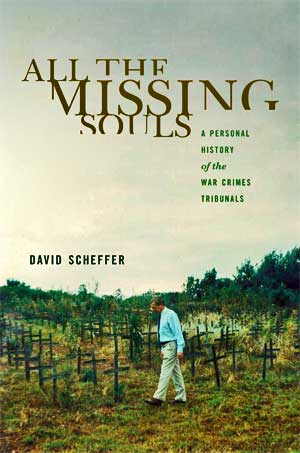
All the Missing Souls
David Scheffer All the Missing Souls: A Personal History of the War Crimes Tribunals Princeton University Press570 pages, 6 x 9 inches ISBN 978 0691140155
Available here →February 1, 2012
20120201-scheffer-david-on-all-the-missing-souls-3-1
A close-up
The rest of this thread

David Scheffer
David Scheffer is the Mayer Brown/Robert A. Helman Professor and Director of the Center for International Human Rights at Northwestern University School of Law. He was the U.S. Ambassador at Large for War Crimes Issues between 1997 and 2001, and senior adviser and counsel to the U.S. Permanent Representative to the United Nations, Dr. Madeleine Albright, between 1993 and 1996. Scheffer led the U.S. delegation to U.N. talks establishing the International Criminal Court. Foreign Policy listed him among the “Top Global Thinkers of 2011.”
Pull this thread
The tribunals of the 1990s ended immunity for heads of state who commit atrocities.
Know something the rest of us don't?
Most threads on Rorotoko begin with our invitation. Any thread can begin with a proposal: you write it with the same prompts every thread answers, and we review it.
Propose a thread →