
Brad Gregory
The Unintended Reformation
The book challenges common assumptions about historical explanation and method, the nature of the Reformation, the making of the modern world, and the character of contemporary life in North America and Europe. For this reason, the Introduction is critically important. It explains the rationale for proceeding as I do. In order to understand the book’s aim and structure, the Introduction must be read first. The Conclusion is also important, as it draws together the six chapters into a concise narrative summary.
A reader browsing randomly through the book might wonder what divergent metaphysical theories, the culture wars, climate change, intractable moral disagreements, and the secularized academy have to do with each other or with the Reformation. One of the book’s arguments is that disciplinary specialization and the fragmentation of knowledge prevent us from seeing important connections among phenomena ordinarily studied separately. Moreover, the tendency of many historians to concentrate on different types of history—cultural, social, economic, political—to the relative exclusion of others diminishes our comprehension of the past. All these types must be incorporated because of their combined explanatory power, a corollary of their interrelated historical influence.
This book is written against the widespread assumption of a supersessionist conception of history. Despite the radical transformations wrought by modernity, the Reformation era continues to influence the present in profound ways. Once the past is gone, it is not necessarily over. This has implications for how historians think about change over time, some aspects of historical causality, and how historical fields are construed chronologically.
Editor: Erind Pajo
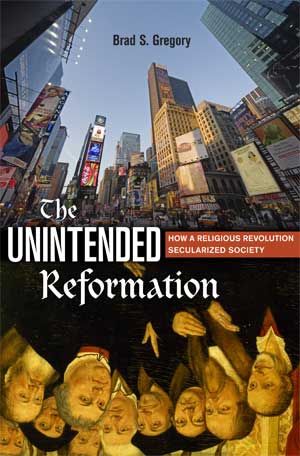
The Unintended Reformation
Brad S. Gregory The Unintended Reformation: How a Religious Revolution Secularized Society Belknap Press of Harvard University Press 592 pages, 6 1/4 x 9 3/8 inches ISBN 978 0674045637
Available here →January 25, 2012
20120312-gregory-brad-science-religion-not-incompatible-3-1
A close-up
The rest of this thread

Brad Gregory
Brad S. Gregory is the Dorothy G. Griffin Associate Professor of Early Modern European History at the University of Notre Dame, where he has taught since 2003. He is the author of Salvation at Stake: Christian Martyrdom in Early Modern Europe (Harvard, 1999), which received six book awards, and in 2005 was the inaugural winner of the Hiett Prize in the Humanities.
Pull this thread
Today's hyperpluralism is the unintended long-term product of the Reformation's doctrinal deadlock, which the modern settlement institutionalized rather than solved.
Know something the rest of us don't?
Most threads on Rorotoko begin with our invitation. Any thread can begin with a proposal: you write it with the same prompts every thread answers, and we review it.
Propose a thread →