
Michael E. Mann
The Madhouse Effect
The Madhouse Effect is, by design, a book that readers can just pick up, skim through, and find a page that both engages and informs. If a reader were to browse only a few pages, my co-author Tom and I might want them to check out the preface. It’s entitled “Why We Wrote This Book.” It provides with a sense of how it is that a climate scientist and an editorial cartoonist would come to collaborate as we did. It conveys the tremendous urgency of acting to avert catastrophic climate change.
The closing pages of the book could also be a very good entry point. Here we give the reason for cautious optimism, despite the many challenges that we currently face when it comes to climate action.
The Madhouse Effect has newfound prescience. Unforeseen when it was first published in early Fall 2016 is the relevance that the phenomenon of climate change denial now has, after the November 2016 U.S. presidential election.
To the extent we might have seemed to have escaped it, we now find ourselves very much back in the madhouse of climate change denial. If previously the clock has been ticking, depending on the new administration’s actions, we may be facing a clock that could run out. That makes the challenge of acting to avert catastrophic climate change even greater now than it was before.
That, in turn, makes it even more important that individuals engage in the actions that we motivate in the final chapter of The Madhouse Effect — grassroots efforts to mobilize public concern and support for action, putting pressure on our elected representatives, and encouraging international cooperation.
There is still reason for cautious optimism given the progress both in the U.S. and abroad in moving away from fossil fuels. We have seen policy progress at the international level — the 2015 Paris agreement and the commitment to build on it.
While Trump and climate-change denying republicans might deal a temporary setback, they cannot ultimately stem the tide — the world has decided it is time to move beyond the antiquated age of fossil fuels. We will solve the problem. If anything, this message of The Madhouse Effect is even more salient now than it was when the book was published.
Editor: Judi Pajo
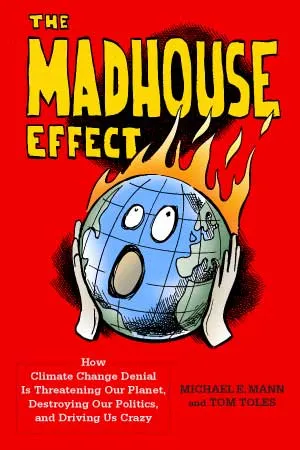
The Madhouse Effect
Michael E. Mann and Tom Toles The Madhouse Effect: How Climate Change Denial Is Threatening Our Planet, Destroying Our Politics, and Driving Us Crazy Columbia University Press 208 pages, 6 x 9 inches ISBN 978 0231177863
Available here →March 29, 2017
20120314-mann-michael-on-hockey-stick-climate-wars-3-1
A close-up
The rest of this thread

Michael E. Mann
Michael E. Mann is Distinguished Professor of Atmospheric Science and Director of the Earth System Science Center at Penn State. He has authored more than 200 publications, including three books, Dire Predictions: Understanding Climate Change, and The Hockey Stick and the Climate Wars and The Madhouse Effect, featured in his two Rorotoko interviews. Mann was selected by Scientific American as one of the fifty leading visionaries in science and technology in 2002, was awarded the Hans Oeschger Medal of the EGU in 2012 and the National Conservation Achievement Award of the NWF in 2013. He made the Bloomberg News list of fifty most influential people in 2013. In 2014, he received the Friend of the Planet Award from NCSE. Michael E. Mann is a Fellow of the AGU, AMS, and the AAAS.
Pull this thread
Climate denial is a funded disinformation campaign that has worked.
Know something the rest of us don't?
Most threads on Rorotoko begin with our invitation. Any thread can begin with a proposal: you write it with the same prompts every thread answers, and we review it.
Propose a thread →