
Stephen J. Shoemaker
The Death of a Prophet
The introduction will give readers the best overview of the issues and questions that the book engages, as well as its broader intellectual context. Nevertheless, I attempted to write the book so that each of its four chapters could be read largely on its own.For some readers the most interesting material may be in the third chapter, which deals with the question of imminent eschatology in earliest Islam, that is, belief that the end of the world was very near at hand. This topic raises fundamental questions about the nature of primitive Islam and its religious outlook and invites considerable suspicion regarding the traditional narratives of Islamic origins. It also challenges widely held contemporary views of Muhammad as primarily a social and economic reformer or the architect of a pan-Arab “nationalist” or “nativist” movement. Moreover, this investigation of early Islamic beliefs about the end of the world proceeds in a methodologically comparative fashion, drawing comparisons to study of the historical Jesus and primitive Christianity. This chapter thus will especially interest readers with expertise and interest in biblical studies or the comparative study of religion.Some of my primary wishes for the book’s implications and consequences are implicit in the answer to your second set of questions. I hope that the book will spur further discussion about Islam’s development within the broader context of religion in the late ancient Near East. We need to examine the beginnings of the earliest Islamic tradition not as something that burst into the Mediterranean and Mesopotamian world already fully formed but instead as a phenomenon that continued to develop rapidly even after it entered these new milieux.Likewise, I hope that this study might encourage more widespread incorporation of methods and perspectives from biblical studies to the study of formative Islam. Although scholars of early Islam have often resisted and even explicitly rejected the relevance of these approaches, they offer valuable new avenues for investigating the beginnings of Islam. This is particularly true for methods used in New Testament and historical Jesus studies, which have been largely ignored as models to this point, despite the fact that there are important similarities in the nature of the early Christian and Islamic materials.By introducing historical-critical approaches developed in the study of Jewish and Christian origins we might achieve greater methodological and ultimately pedagogical unity within the discipline of religious studies.The pedagogical implications, although often overlooked, are significant. Undergraduate textbooks regularly present accounts of early Judaism and early Christianity that are based on the critical discourses of scholarship that have developed around Jewish and Christian origins, and accordingly these differ significantly from the traditional accounts. The early history of Islam, by contrast, is generally presented largely according to the traditional Islamic view, despite the significant weaknesses of the relevant sources. As an educator, I think it would be helpful to present these traditions on a more consistent basis, and hopefully, more skeptical approaches to the early history of Islam can move us in this direction.
Editor: Erind Pajo
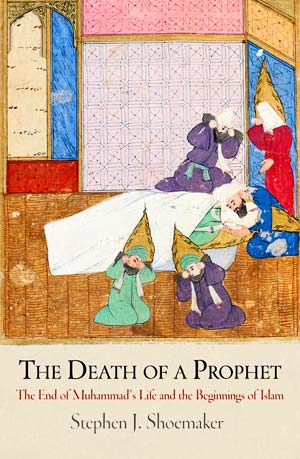
The Death of a Prophet
Stephen J. Schoemaker The Death of a Prophet: The End of Muhammad's Life and the Beginnings of Islam University of Pennsylvania Press416 pages, 6 1/4 x 9 1/4 inches ISBN 978 0812243567
Available here →April 24, 2012
20120424-shoemaker-stephen-on-death-prophet-end-muhammad-life-begin-islam-3-1
A close-up
The rest of this thread

Stephen J. Shoemaker
Stephen J. Shoemaker is Associate Professor of Religious Studies at the University of Oregon. He is a specialist on religion in the late ancient Near East and has published widely on Christian traditions about the Virgin Mary as well as on the beginnings of Islam. Besides The Death of a Prophet, featured on Rorotoko, he is also the author of Ancient Traditions of the Virgin Mary’s Dormition and Assumption (Oxford, 2002) and the translator of Maximus the Confessor: The Life of the Virgin (Yale, 2012).
Pull this thread
Muhammad leading his followers into Palestine in 634–35 is an earlier tradition than his death at Medina in 632.
Know something the rest of us don't?
Most threads on Rorotoko begin with our invitation. Any thread can begin with a proposal: you write it with the same prompts every thread answers, and we review it.
Propose a thread →