
Frances Guerin
Through Amateur Eyes
I would hope that the browser who picked up Through Amateur Eyes in a bookstore would turn to the image section in the middle of the book.
The archival images that the book discusses and analyses are unique and very powerful, primarily because of their age, but also because they take us to places that we would not otherwise go. There is something really amazing about seeing a reproduction of a photograph that has sat in an old soldier’s attic for seventy years, and that takes us inside his experiences on the battlefield. I also think the University of Minnesota Press has done a brilliant job in the reproduction of these images.
And , without these old photographs and films, there is no book. As far as was possible I insisted on placing the image and its concerns at the center of my interpretations. Thus, the images need to be the first thing readers see, and I believe that the images will hook any reader into the rest of the book.
My favorite chapter is Chapter Three, on the photographs of Walter Genewein. He was the Chief Accountant of the Lodz Ghetto, and was involved in overseeing its massive wartime production. The Ghetto itself is fascinating because it was hermetically sealed, meaning that it was fully self-sufficient, but also an inescapable prison.
Genewein found a camera in among the goods that had been confiscated from the Jews on arrival, and he started taking photographs with it around 1939. He saw himself as an amateur photographer and really believed he was photographing the reality of day-to-day life in the Ghetto. But of course, his vision is only one perspective of the tortuous living conditions in the Lodz Ghetto. The photographs tell of his mission to promote the efficiency and productivity of the Ghetto, but, contrary to his intentions, they also let slip other realities. In the photos we see the oppression, the inhuman conditions, the hardships suffered.
Genewein also became somewhat obsessive about the scientific reality of the photographic image, and he used his existing relationship with I G Farben (to whom he paid the bills for the dyes used in the Ghetto’s clothing workshops), giving them directions about how to perfect the film material.
So in Genewein’s images we find an amazing confluence of circumstances, all of which are dependent on the ghettoization of the Lodz Jews.
The discovery of Genewein’s images is another wonderful tale full of twists and turns. They first turned up in a used bookstore in Vienna, where they were given by a “friend” of the Chief Accountant’s. They came in a handmade wooden box, each one numbered and titled, in Genewein’s fastidious way. Then they were exhibited in Frankfurt at the Jewish Museum, where the filmmaker Dariusz Jablonski saw them and wove them into his film Amateur Photographer. Some years later a whole duplicate set turned up in a yard sale in Bethesda, the suburb of Washington DC. They came in a box marked “Daddy’s Europe Oldies”, and a piece of paper inside tells us they were found and brought back to the US by a liberator. The paper inside read: “Slides from a Jewish Ghetto (German Labor Camp) Litzmannstadt, Poland. Found in home of German Director of camp in Bremen Germany.” Genewein numbered all of his images, and when those found in Bethesda are put together with those given to Löcker, we realize there are gaps, numbers missing from the series.
And so, we know there are still slides that have not yet been discovered. The story of Genewein’s images has not yet come to an end. This open-endedness attracts me, because it is the basis of my interpretations that, as I say, are only one perspective, which like Genewein’s, is a perspective that can never be a definitive accounts of what took place in this chapter of history.
My wishes with regard to the book’s implications? I would be happy if Through Amateur Eyes is able to reinforce the importance of looking and looking again, always through different eyes at this troubled period in twentieth century history.
The consequences and implications of the Holocaust are still with us today, and we must continue to learn from the mistakes we made. I say “we,” because this is a history that effects all of us, a history for which, as Alain Resnais told us in 1955 in Night and Fog, we are all responsible.
We need to look at this period from every possible perspective, through every lens that offers itself to us. Germans were often the ones who had access to cameras to take both still and moving images during World War II, and we can’t afford to discount these images from our narratives of remembrance because they are taken by Germans. On the contrary, because these images exist, we must take them seriously. It is no longer viable to make the argument that because the images are taken by Germans they don’t tell the truth, that they are so overwhelmed by Nazi ideology that we cannot turn to them for insight.
We live in an era when it is accepted that there is no single truth, no single perspective of any event. And so we have to trust that, even if the images tell us no more than what the Germans were looking at, what they were thinking at the time, we need to see and to know what they saw and thought.
Editor: Erind Pajo

Through Amateur Eyes
Frances Guerin Through Amateur Eyes: Film and Photography in Nazi Germany University of Minnesota Press 352 pages, 6 x 9 inches ISBN 978 0816670062 hb ISBN 978 0816670079 pb
Available here →May 14, 2012
20120514-guerin-frances-on-amateur-eyes-film-photography-nazi-germany-3-1
A close-up
The rest of this thread
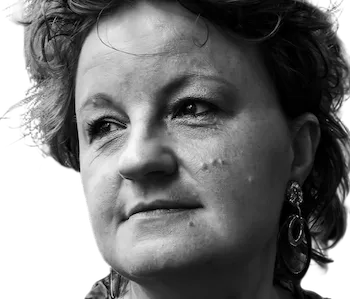
Frances Guerin
Frances Guerin teaches in the School of Arts at University of Kent, Canterbury. Besides Through Amateur Eyes, featured on Rorotoko, she is the author of A Culture of Light: Cinema and Technology in 1920s Germany (Minnesota, 2005) and co-editor of The Image and the Witness: Trauma, Memory and Visual Culture (Wallflower, 2007). Her book The Truth is Always Grey: From Grisaille to Gerhard Richter is forthcoming. Guerin’s articles have appeared in international journals, including Cinema Journal, Screening the Past, and Film and History. You can read her blog at fxreflects.blogspot.com.
Pull this thread
Amateur films and photographs Germans made during the war are evidence in their own right.
Know something the rest of us don't?
Most threads on Rorotoko begin with our invitation. Any thread can begin with a proposal: you write it with the same prompts every thread answers, and we review it.
Propose a thread →