
Mary Roberts
Istanbul Exchanges
I hope a reader who stumbles across this book might initially be drawn to the visual richness of this art and then engaged by their cross-cultural narratives. These images are drawn from internationally diverse sources; finding them has been an adventure. When I first began travelling to Istanbul, many of these paintings were in obscure corners of the former Ottoman palaces on the Bosphorus, and many were uncatalogued. It is my conviction that drawing together this visual archive, that will come to form part of a new canon of a global history of nineteenth-century art, can challenge our theoretical presuppositions about cultural production in this period.The one artwork that is likely to be familiar to readers is Jean-Léon Gérôme’s The Snake Charmer. This painting takes us to the heartland of the Orientalism debate. It was made famous (or more perhaps more accurately, it became notorious) when reproduced on the cover of Edward Said’s seminal book, Orientalism in 1978. Since then Gérôme’s work has come to exemplify the binary logic of the European discourse through which Western visual culture produced the East as its other. My book disrupts these entrenched understandings of Gérôme’s art by resituating his orientalism within a broader reception history, encompassing international networks of pedagogy and Ottoman patronage.Gérôme’s works were among the contemporary art that Sultan Abdülaziz and his aide-de-camp (Gérôme’s former student), Şeker Ahmed Paşa, purchased for the Ottoman palace through the French dealers Goupil et Cie in the 1870s. Contextual analysis of these works enables us to consider what they meant to an Ottoman audience and to situate these collecting practices within the semantic economy of Goupil’s international networks of image replication and circulation.The acquisition of Gérôme’s paintings for the Ottoman palace reveals the mutable semiotics of his Orientalism. Among an elite Ottoman audience in Istanbul they were transmuted into Ottoman Orientalism. One of these paintings, generically titled Bashi-Bazouk Dancing, was renamed in Istanbul. Ottoman viewers recognized it as a representation of the distinctive costume and dance of the Zeybek warriors from the mountain regions of Western Anatolia. They had been part of the irregular Ottoman forces and their itinerant existence and distinctive traditional dress was the antithesis of Ottoman palace life governed by formality and protocol. Indeed the range of representations of Ottoman culture within the sultans’ art collection, which by the end of the century came to include numerous paintings of Arab horsemen from the empire’s peripheries, provided a visual précis of the empire’s diversity for its elite audience. As such they were a reminder of cultural patrimony – that which distinguished the Ottoman Empire from Europe –within the contextualizing frame of the modern Ottoman palace.In 1878 Gerome borrowed his Zeybek painting back from the Ottomans in order to display it in the Paris International Exposition. So too, the painting was reproduced as a print that circulated widely across Europe and America. In these contexts the Ottoman warriors took on more exotic, Orientalist connotations. By tracking the circulation of this painting from Paris to Istanbul to Paris and then back again, the life of their reprographic double, and the variant titles that this painting accrued as a result of these transitions, my study exposes a complex range of meanings for divergent audiences.This broader cross-cultural interpretive work reveals a more entangled politics of spectatorship for Gérôme’s Orientalism than Linda Nochlin’s formulation about his art that, “The white man, the Westerner, [exerts] … the controlling gaze, the gaze which brings the Oriental world into being, the gaze for which it was ultimately intended.”If we approach this distinct context without critically analysing the appropriateness of the art historical tools we are using we risk replicating a narrative of this modern art beyond the Western European cultural capitals as derivative and belated. Accordingly, in Istanbul Exchanges I propose a shift in emphasis from institutions to networks.Over the last three and a half decades the social history of nineteenth-century French and British art has developed a reception theory premised upon the large and centrally organized art institutional structures of the Royal Academy and the Salon. Whether artists based in these Western European cities sought to be embraced by these academic institutions or defined their practice as part of an avant-garde that rejected such structures, the institutions of the Salon and Academy remained the most powerful defining features of that art milieu.In Istanbul a different situation prevailed. Art circulated within linguistically and culturally diverse local, foreign, and expatriate communities. It could be seen in the Ottoman palaces, foreign embassies and Christian churches, as well as in the homes of the Ottoman elites, the expatriates, and Levantines. It was taught in private studios in Pera run by European-trained foreigners, in the Ottoman military academy, and in select government and minority community schools.In the 1870s and 1880s, reports and reviews of art exhibitions appeared in local Ottoman, expatriate, and Armenian newspapers, and yet, like the exhibitions themselves, this art writing was sporadic and unsystematic. There was no extensive art-critical press in Istanbul, unlike in London and Paris, where a culture of regular reviews sustained a broader bourgeois public for art. The audience for art in Istanbul in this period is more divergent and disparate than in the Western European capitals, thus compounding the challenge of providing a precise definition of the public for art in this city.My analysis of Istanbul’s art exhibitions reveals contested definitions of Ottoman and Orientalist cultural identity. These exhibitions have been absent from the lively debates within the Anglo-American academy about nineteenth-century exhibition culture. Unlike the annual exhibitions at the European art academies and the international exhibitions held around the globe, Istanbul’s art exhibitions were without institutional infrastructure or significant international profile. But the very cause of their marginality, I argue, is also the source of their revisionary potential.The inclusion of Ottoman artists distinguishes these exhibitions from societies of Orientalist painting in Europe. These provisional and loosely structured collaborations encompassed overlapping societies and audiences with a range of agendas and national affiliations. Their diverse agendas distinguish them from official Ottoman displays at the European World’s Fairs and Istanbul’s state-sponsored museums. Reviews of the Istanbul exhibitions published in Istanbul, London, Copenhagen, and Tiflis discloses remnant gossamer threads of intersecting networks within diverse local communities and the links between them and the art world internationally. At times these networks were divided along the fault lines of national allegiance in response to contemporary political debates, but a study of these exhibitions also reveals the sense of multiple belonging of many of Istanbul’s artists (especially those who were members of Ottoman minority communities). A study of their fraught critical reception in Istanbul provides unique insights into the varied ways cross-cultural collaboration was imagined, interpreted and contested.
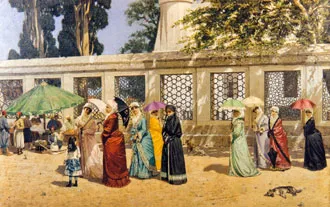
Osman Hamdi Bey, Women in Feraces, 1887, Oil on Canvas, 81 x 131 cm. Yapı Kredi Painting Collection, Istanbul
Editor: Judi Pajo

Istanbul Exchanges
Mary Roberts Istanbul Exchanges: Ottomans, Orientalists, and Nineteenth-Century Visual Culture University of California Press280 pages, 7 x 10 inches9780520280533
Available here →February 1, 2017
20170201-roberts-mary-on-istanbul-exchanges-ottomans-orientalists-3-1
The wide angle
The rest of this thread

Mary Roberts
Mary Roberts, Robert Sterling Clark Visiting Professor in Art History, Williams College and Professor of Art History, University of Sydney, was awarded the Art Association of Australia and New Zealand’s Book Prize for Istanbul Exchanges. She is a leading figure in Orientalist and Ottoman art studies, with particular expertise in the art and culture of travel. Her first book was Intimate Outsiders: The Harem in Ottoman and Orientalist Art and Travel Literature. She has co-edited four other books and has received numerous awards and fellowships. Her next book is on Artists as Collectors of Islamic Art.
Pull this thread
An artwork's meaning belongs to the circuit it moves through, not to its maker.
Know something the rest of us don't?
Most threads on Rorotoko begin with our invitation. Any thread can begin with a proposal: you write it with the same prompts every thread answers, and we review it.
Propose a thread →