
Aaron Cowan
A Nice Place to Visit
Chapter 3, which explores the campaign in the 1970s to build a convention center in downtown St. Louis, is probably the chapter that really cuts to the heart of the conflicts taking place in these cities. City leadership proposed a $21 million public bond issue to build the center, at the moment that the city’s economy was in free fall, and suburban migration was rapidly depleting the residential tax base.
The proposed convention center site was also controversial – it sat right on the northern edge of downtown, adjacent to the city’s Northside, a struggling working-class, largely African American, neighborhood. Standing at the site, one could see underfunded public housing projects, potholed city streets, and blocks of dilapidated housing owned by absentee slumlords. Working-class political activists, especially in the Black community, mounted a strident campaign against the publicly financed convention center, but ultimately lost their battle. The Northside continued to decline, and the convention center continued to absorb millions in public subsidy over the following decades.
The St. Louis story is a stark depiction of the shifting priorities of urban leadership in the postwar era, when large flashy development projects became more important than things like housing, schools, and basic governmental services. Cities began to believe they could build their way out of economic decline, and it had real consequences for people’s lives.
On a somewhat brighter note, Chapter 5, on Baltimore’s Inner Harbor, is another favorite because there I relate fantastic examples of local residents refusing to cede tourist spots over to out-of-towners completely. To give just one example: in the city mayor’s papers, I found numerous letters from suburban white visitors concerned about groups of black teenagers gathering on the promenade, playing loud music, and dancing.
I finally figured out that Harborplace (the “festival marketplace” built on the Inner Harbor) had become, in the early 1980s, one of the key spots for the city’s early hip-hop scene. It provided a central meeting place for kids from all around the city, and a built-in audience for rappers and dancers. So this demonstrates one of the ways in which urban residents exploited the opportunities provided by Harborplace to create and nurture a singular culture not dictated by the official power structures that defined their lives in so many other ways. The function of tourist sites, like all urban spaces, is never simply defined by the elites – it is always contested and layered with different meanings.
Tourism is one of the largest and fastest-growing industries in the world, and it has an important role to play in the postindustrial American city. Cities should be entertaining and attractive places to visit. Tourism is obviously a major industry that cities cannot afford to neglect entirely. The rise of the tourist economy created a new economic function for downtowns, and did bring a new kind of vitality to American cities. The historical narrative in A Nice Place to Visit, however, suggests that an overzealous dedication to enhancing this role at the expense of the greater urban community leads to discord, resentment, and the remaking of central cities to serve the interests and tastes of outsiders rather than locals.
Tourism continues to be an attractive lure to cities that see it as a panacea for economic ills. Cities continue to offer tax abatements and millions in public subsidy to casino developers and professional sports franchises, even as budgets for public schools and municipal services are cut to the bone.
I would like to believe that the stories in my book would give governmental and business leaders pause; not to reject tourism altogether, but to ask questions like: How can we develop a successful urban tourist economy that doesn’t alienate a city’s residents? How do we make sure the benefits of tourist development are equitable and that tourism truly contributes to the greater good of a community, not just hotel chains or global corporations?
I would hope that those with the power to shape the urban political economy would thoughtfully consider ways to insure that our cities are both “nice places to visit” and also good, just communities, in which to live.
Editor: Judi Pajo
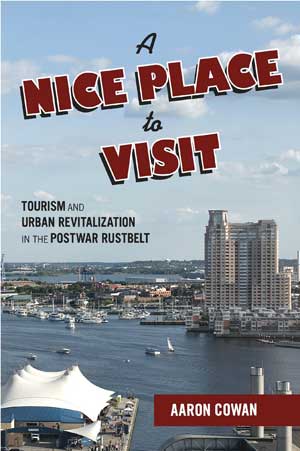
A Nice Place to Visit
Aaron Cowan A Nice Place to Visit: Tourism and Urban Revitalization in the Postwar Rustbelt Temple University Press 234 pages, 6 x 9 inches ISBN 978 1439913468
Available here →May 10, 2017
20170510-cowan-aaron-on-nice-place-visit-tourism-urban-revitalization-3-1
A close-up
The rest of this thread

Aaron Cowan
Aaron Cowan is Associate Professor of History at Slippery Rock University in western Pennsylvania. His research and teaching interests include urban, environmental and public history. He is also founder and co-director of Slippery Rock University’s Stone House Center for Public Humanities, an initiative that seeks to expand public appreciation of the humanities and their relevance to contemporary life.
Pull this thread
Rustbelt cities turned to tourism not because it worked but because postwar leaders had few other options.
Know something the rest of us don't?
Most threads on Rorotoko begin with our invitation. Any thread can begin with a proposal: you write it with the same prompts every thread answers, and we review it.
Propose a thread →