
Justin V. Hastings
A Most Enterprising Country
North Korean restaurants are tourist attractions in many cities, and are often the closest the average person will ever get to North Koreans. And indeed, they were one of the inspirations for the book. Toward the beginning of my research, I came across a North Korean restaurant in a city in northeastern China. The restaurant itself was a block or two down from a branch of a popular South Korean coffee, waffles, and ice cream chain, indicating that perhaps North Koreans were not as isolated (even from South Koreans) as one would think. The façade of the restaurant was festooned with a giant North Korean flag, and advertised—in Chinese—the fact that it sold dog meat. The North Koreans had clearly established a niche for themselves that Chinese and South Korean restaurants were wary of (publicly) occupying.
In its restaurants, North Korea is essentially using its ‘brand’—isolated and exotic—to make money.
If we take a step back, the whole idea of a North Korean restaurant seems a bit odd. What kind of a paranoid Stalinist country runs its own international restaurant chain? The book’s third chapter goes into depth about these restaurants, which are sprinkled throughout Asia, particularly China. Many different North Korean companies have set up a variety of different business arrangements, from wholly owned restaurants to joint ventures with local companies, through to hiring out waitresses to regular Chinese restaurants to attract business. The restaurants themselves are usually decorated with North Korean art, and the waitresses generally present a song and dance routine every evening for customers (with a combination of North Korean patriotic songs and Western rock songs). The waitresses themselves are daughters of the elite, and often have several years of training in North Korea. They can, within limits, indicate their preferences about where to work.
They live near the restaurant under the watchful eye of minders. They are not allowed to interact with local people, are often mistreated, and occasionally attempt to escape, but the fact that many of them sign up seemingly voluntarily suggests that they must make a terrible choice between living and eating in China, or not necessarily having anything to eat in North Korea. The existence of the restaurants is an example of both the entrepreneurial nature of North Koreans, and the difficult choices they must make to survive.
The enterprising nature of North Korea’s trade networks cuts both ways. It is a testament to the resilience of average North Koreans who have found creative ways to survive under terrible conditions. But it also shows how the North Korean state has been able to ‘flourish,’ inasmuch as state trading networks have been able to evade sanctions and other attempts to stop Kim Jong-un from profiting off the population’s suffering. Even as sanctions have tightened with every nuclear or missile test, Pyongyang has experienced a building boom, the North Korean won and food prices in the capital appear to be stable, and the North Korean economy seems to growing at a very modest clip.
This has several implications for how we think about North Korea. The old view of North Korea as Communist, paranoid, totalitarian, and cut off from the world is not really accurate, and is not particularly useful in dealing with the country. The population of North Korea is increasingly untethered from the state in terms of its survival. North Korea is unlikely to collapse solely due to economic catastrophe, and waiting for the regime to fall is not a viable long-term strategy.
At the same time, precisely because North Korean trade networks have been so enterprising, Kim Jong-un may be prone to riskier behavior, inasmuch as he is freed from the need to provide for the population, and is confident that state-owned companies can evade any sanctions thrown at them. The end of North Korea is likely to come more from political challenges and outside pressure than economic tribulations.
Editor: Judi Pajo
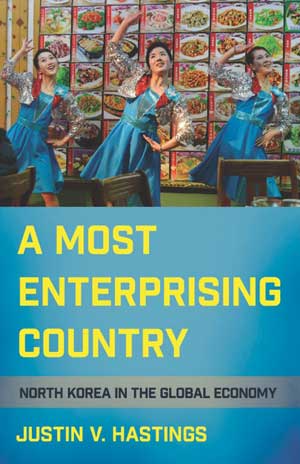
A Most Enterprising Country
Justin Hastings A Most Enterprising Country: North Korea in the Global Economy Cornell University Press 240 pages, 6 x 9 inches ISBN 978 1501704901
Available here →May 31, 2017
20170531-hastings-justin-on-most-enterprising-country-north-korea-global-3-1
A close-up
The rest of this thread

Justin V. Hastings
Justin Hastings is Associate Professor in International Relations and Comparative Politics and an Australian Research Council Future Fellow at the University of Sydney. He is also the author of No Man’s Land: Globalization, Territory, and Clandestine Groups in Southeast Asia (Cornell University Press, 2010).
Pull this thread
North Korea survives because of its integration with the global economy, not despite isolation from it.
Know something the rest of us don't?
Most threads on Rorotoko begin with our invitation. Any thread can begin with a proposal: you write it with the same prompts every thread answers, and we review it.
Propose a thread →