
Brooks E. Hefner
The Word on the Streets
The best entry point for the book is probably the introduction. I use that rather lengthy section to demonstrate the permeability of modernist boundaries and to lay out my argument for exactly what vernacular modernism is and how it works: how it relates to modernist writing and how it differs from popular nineteenth century dialect writing that understood language as marking strict social hierarchies. I also use the introduction to highlight the importance of popular linguistics in the era, a legacy of Mencken’s American Language. Readily incorporating “foreign words and phrases” (in Mencken’s words), this fast-moving, constantly innovating American language meant that slang dictionaries and word-lists (produced at an astounding rate during this time) were likely obsolete by the time they reached publication.
The introduction also situates this vernacular modernism within what I call the political economy of modernist reading. Using Anita Loos’s Gentlemen Prefer Blondes, I track the ways in which this text moved with ease across a variety of boundaries between highbrow and middlebrow readerships, noting that its impact seems to derive in part from this very motion.
If a reader is looking for a case study to sink her teeth into, then I would suggest turning to the chapter on hard-boiled crime fiction. With a focus on the well-known detective writer Dashiell Hammett and his lesser-known antecedent Carroll John Daly, it teases out quite a few of the themes and methods that run throughout the book. Linking the self-conscious development of the hard-boiled aesthetic in the pulp magazine Black Mask to the vogue for underworld dictionaries and the semi-canonization of crime writers like Dashiell Hammett, this chapter makes an argument for hard-boiled writers working in a vernacular modernist mode that reflects the power and the politics of vernacular language and slang. It also argues that a turn toward the vernacular served as a watershed moment in the history of crime fiction, replacing the rational realism of classic detective fiction with a modernist world filled with ambiguous meaning and epistemological doubts.
Ultimately, I hope to provide in The Word on the Streets a model for how scholars might begin to rethink the complexity of popular writing. All too often popular writing is trotted out as a kind of raw material that more talented writers transform into capital-L Literature (or capital-M Modernism) through some form of literary alchemy. And this can happen even in well-meaning studies that seek to promote popular writing as radical or valuable. My method here is to give these writers some credit for being more than merely “fiction factories” writing for money; in my account, these writers are deliberate about their choices and deeply interested in the power and complexity of language.
By giving these writers credit for understanding and practicing their craft, The Word on the Streets steps away from ideological readings that indict writers—especially popular and middlebrow writers—for their complicity with power structures. I wouldn’t exactly call this approach “postcritical” (in the way the Rita Felski describes such a method), but I would say that if we want to preserve the gains of cultural studies—in particular, the diversification of the canon—we need to acknowledge that these writers were often quite articulate about their own writing practice. Whether it is the strategic use of urban vernacular and street slang in the Harlem novels of Rudolph Fisher and Claude McKay as a means of raising questions about the politics of uplift in the Harlem Renaissance, or the emphasis on working-class and baseball slang in Ring Lardner to revise the class dynamics of American humor, these vernacular modernists mounted their own critique of nineteenth-century linguistic conventions and offered new possibilities for the genres they transformed.
The vernacular modernists I discuss are well aware of the complicated politics of language in the modernist era: a moment characterized by nativist and anti-immigrant sentiment, labor unrest, and racial discrimination and violence. In each of my case studies, I tease out the ways in which the transformation of each of these individual genres wrestles directly with how language—both standard and non-standard vernacular languages—remains deeply connected to these politics.
Editor: Judi Pajo
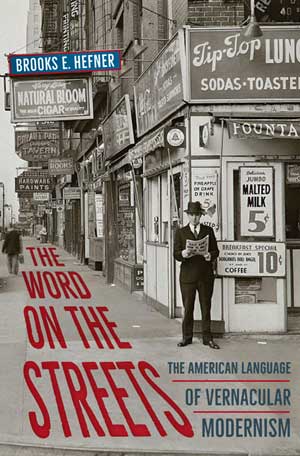
The Word on the Streets
Brooks E. Hefner The Word on the Streets: The American Language of Vernacular Modernism University of Virginia Press 296 pages, 6 x 9 inches ISBN 978 0813940403
Available here →October 31, 2017
20171030-hefner-brooks-on-book-word-streets-american-language-vernacular-3-1
A close-up
The rest of this thread

Joe Fitzgerald
Brooks E. Hefner
Brooks E. Hefner is associate professor of English at James Madison University, where he teaches courses in American Literature, American Studies, and Film Studies. His scholarship has appeared in PMLA, Modern Fiction Studies, MELUS, Journal of Film and Television, and other venues. He is the author of The Word on the Streets: The American Language of Vernacular Modernism, featured in his Rorotoko interview, and is the co-director of the NEH-funded Circulating American Magazines, a digital humanities project that will offer circulation data and data visualizations for American magazines from 1868-1972.
Pull this thread
Pulp writers used slang as a deliberate experiment, so they belong inside modernism.
Know something the rest of us don't?
Most threads on Rorotoko begin with our invitation. Any thread can begin with a proposal: you write it with the same prompts every thread answers, and we review it.
Propose a thread →