
Andrew Feenberg
Technosystem
Technosystem begins with a lecture that sums up much of the argument in non-technical language. I use two illustrations to make my points. A reader browsing the book would be amused by pages 9-12 where I develop the argument around an Escher print and a cartoon from The New Yorker. That would be a good starting point.
Escher's Drawing Hands shows two hands drawing each other. The circularity of the image is paradoxical. This illustrates the way in which social groups in modern societies are formed around technical artifacts and systems which their members modify as they work within them. We both shape and are shaped by the technologies, the markets and the bureaucracies that organize our social life. This is co-production.
But Escher's print is the product of an artist who stands outside the paradox he depicts. No one draws Escher as he draws Drawing Hands. Is there an equivalent external position in the rational society? Many think there is. The scientist, the engineer, the economist, the management theorist, all appear to stand outside the system governed by the laws they discover. This is the illusion of technology, the false belief that there is an external place to stand from which to know and organize society. But society is not a technical project. This is illustrated by the cartoon which I leave to future browsers to discover.
Our first child was born in the early 1970s during an upsurge in feminist demands for more humane obstetric procedures. The admission of partners to labor and delivery rooms was the most important reform resulting from this agitation. We were among the first lucky ones to enjoy this new dispensation. This is where I discovered the theme of this book. The astonishing experience of admission to the process of birth, in violation of long-standing medical tradition, got me thinking about how arbitrary are many of the rules and regulations we take for rational.
This was not the only time I was reminded of the social influences on what are ostensibly purely rational procedures. I worked with a medical research foundation and a research institute that created the first online education program. These experiences confirmed my belief that the "rational society" is no technocratic utopia, but the scene on which social forces confront each other. There are many opportunities today in this period of political turmoil over environmentalism to measure the limits of rationality as a social form.
Technosystem provides a theoretical framework for an insight that comes to us in fragments from time to time. It aims to defend citizen agency against the frequent unjustified ideological appeals to rationality that characterize our political life. This is ultimately what I hope Technosystem can communicate to its readers.
Editor: Judi Pajo
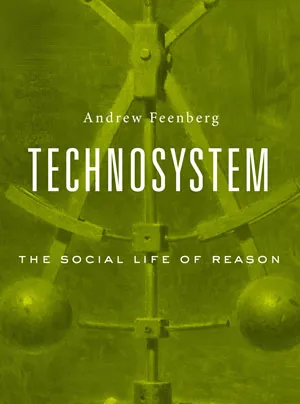
Technosystem
Andrew Feenberg Technosystem: The Social Life of Reason Harvard University Press 256 pages, 6-1/8 x 9-1/4 inches ISBN 978 0674971783
Available here →December 18, 2017
20171218-feenberg-andrew-on-book-technosystem-social-life-reason-3-1
A close-up
The rest of this thread

Andrew Feenberg
Andrew Feenberg teaches in the School of Communication, Simon Fraser University, where he directs the Applied Communication and Technology Lab. He also serves as Directeur de Programme at the Collège International de Philosophie in Paris. His books include Questioning Technology, Transforming Technology, Heidegger and Marcuse, Between Reason and Experience, and The Philosophy of Praxis. His most recent book is Technosystem: The Social Life of Reason, published by Harvard in 2017, and featured in his Rorotoko interview. A book on Feenberg's philosophy of technology entitled Critical Theory and the Thought of Andrew Feenberg, edited by D. Arnold and P. Michel, has also appeared in 2017.
Pull this thread
Rationality is now the dominant ideology, and protest and hacking are how the public co-produces the technical system.
Know something the rest of us don't?
Most threads on Rorotoko begin with our invitation. Any thread can begin with a proposal: you write it with the same prompts every thread answers, and we review it.
Propose a thread →