
Mimi Sheller
Mobility Justice
If you were to encounter this book in a bookstore, I hope you would first turn to the appendix and read the “Principles of Mobility Justice.” These principles range across diverse topics and sections of the book. Some for example, refer to individual bodily movement: “Individual mobility shall not be involuntarily restricted by threats of violence, including enforced forms of clothing, segregated means of movement, or unevenly applying temporal or spatial limits on mobility.” Other principles refer to the scale of the city and transport planning: “Public investments in transport systems shall not afford mobility to some groups by imposing undue burdens, externalities, or limitations on others who do not benefit.” And some refer to the global scale: “People displaced by climate change shall have a right to resettlement in other countries, especially in those countries that contributed most to climate change.” I hope these principles might intrigue you and make you want to find out more.I want readers to think about how these different scales are connected, and why they are all necessary for mobility justice. Maybe you would also flip through the glossary and encounter some new terms and ideas that would entice you to read the book. For example, what is a commons? “Neither state nor market, private nor public, a commons is a shared resource of a community of people with negotiated rules to sustain it and allocates its benefits, according to George Monbiot. According to Michael Hardt and Antonio Negri, the commons ‘designates an equal and open structure for access to wealth together with democratic mechanisms of decision-making. . . it is a social structure and a social technology for sharing.’”Or, for example, what is extractivism? “Extractivism generally refers to an economic model based on the large-scale removal (or “extraction”) of natural resources for the purposes of exporting raw materials, including industrial-scale agriculture, forestry, fishing, mining and hydrocarbons. Such extractive activity, it is argued, does not benefit local economies, produces high rates of underemployment and poverty, leads to unequal wealth distribution, and leaves behind waste and pollution. Extractivism has become a significant subject of political debate, especially in Latin America, where it is contrasted with postextractivism, neoextractivism, and postcapitalism.” Here, I draw on the ideas of Arturo Escobar. One book connects to another, and readers might be led on a journey to read other works, including Anna Tsing, Donna Haraway, Keller Easterling, Deborah Cowen, and others.I believe that a full transition in the currently dominant fossil-fuel based automobility system will only take place when we simultaneously address the issues of social inequality that underpin the un-sustainability of the current system and we begin to promote mobility justice as integral to sustainability. Spatial and cultural contexts for dwelling and moving must be redesigned to promote both sustainable mobility and mobility justice. This may mean restricting or reducing the mobilities and energy consumption of the kinetic elite. Children around the world are currently mobilizing climate marches and school strikes to get politicians to listen to them. They tell us that we need to urgently change the way our current system works. I hope this book will contribute to that movement.In the conclusion of the book I call for “commoning mobility” or creating a “mobile commons” as a possible way forward toward more just and sustainable mobilities. I hope to develop this concept further in my next project, and I hope to find others who want to work on this. I describe commoning mobility as a verb: the enactment of cooperative social territories and shared infrastructures for moving, sharing, and conserving places. Mobile commons have been cooperatively produced by human relation to others, both human and more-than-human, through common passage, translation, and co-usage over time. Commoning mobility empowers assemblages of people-plants-animals-places to exercise generative forms of autonomous social cooperation outside of capitalism. How can we build on and sustain the mobile commons and take our world back from extractivist capitalism and the violent security state?
Editor: Judi Pajo
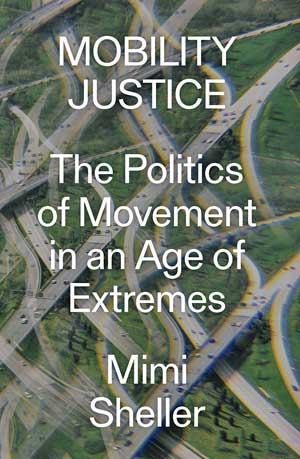
Mobility Justice
Mimi Sheller Mobility Justice: The Politics of Movement in an Age of Extremes Verso240 pages, 6 x 9.2 inches ISBN 978 1788730921
Available here →April 24, 2019
20190424-sheller-mimi-on-book-mobility-justice-politics-movement-age-3-1
A close-up
The rest of this thread

Mimi Sheller
Mimi Sheller is Professor of Sociology and founding Director of the Center for Mobilities Research and Policy at Drexel University in Philadelphia. She is founding co-editor of the journal Mobilities, Associate Editor of the journal Transfers, and past President of the International Association for the History of Transport, Traffic, and Mobility. She helped establish the interdisciplinary field of mobilities research. She is author/co-editor of ten books, including most recently Mobility Justice: The Politics of Movement in an Age of Extremes (Verso, 2018) and Aluminum Dreams: The Making of Light Modernity (MIT Press, 2014).
Pull this thread
The sustainable transition and the just transition are one transition, or neither happens.
Know something the rest of us don't?
Most threads on Rorotoko begin with our invitation. Any thread can begin with a proposal: you write it with the same prompts every thread answers, and we review it.
Propose a thread →