
Adrienne Mayor
Gods and Robots
I picture someone in a bookstore becoming intrigued by the 75 illustrations, especially the 14 color plates showing the stunning skills of fifth-century BC artists. Ancient coins depict the bronze guardian Talos defending Crete from invaders, hurling rocks to sink ships. On a bronze mirror, he hugs victims against his red-hot chest. In vase paintings, Talos reels back and collapses as Medea and Jason destroy him. One vase painter humanized the dying Talos by dabbing a teardrop on his bronze cheek. Another scene shows Jason using a tool to remove the crucial bolt that seals the killer robot’s power source. His vital fluid, ichor, flowed out like molten lead.
Other vase paintings show the gods preparing the replicant maiden Pandora for her baleful mission on earth. She stands stiffly like a wind-up doll with an eerily vacuous smile. Paging through the chapter “Pandora: Beautiful, Artificial, Evil,” one quickly learns that the sentimental fairytale version of Pandora has nothing to do with the original Greek myth. A vengeful Zeus ordered Hephaestus to make an “evil trap disguised as beauty”—in the form of a ravishing young woman—to punish humankind for accepting the gift of stolen fire. Pandora was created to carry out one task.
She opened the jar of misfortune and suffering that would plague mortals forever.
Also eye-catching are the images of Prometheus using tools to build the first human from scratch, starting with the skeleton, carved in exquisite detail on tiny gems.
Another browser’s attention might be captured by Homer’s description of a fantastic fleet of self-navigating ships in the Odyssey. Visiting the Phaeacians, a mysteriously advanced city ruled by King Alcinous, Odysseus explains his heart’s desire to return to his home island after ten years of wandering.
The king offers a voyage on one of his ships. The vessels sail on their own, with no captain and no rowers. Endowed with navigation maps of the known world, they need only to hear the destination to plot the route. Sailing to Ithaca, Odysseus marvels at the ship’s cruising speed of falcons, cutting through all weather and sea conditions. The imaginary Phaeacian ships, with access to vast data archives and charts, prefigure advanced GPS systems.
From time to time, I include references to modern sci-fi films that resonate with the classical myths, such as Metropolis (1927), Frankenstein (1931), Jason and the Argonauts (1963), Blade Runner (1982 and 2017) and TV shows such as Westworld. The mythic tales are certainly cinematic!
The age-old myths and modern movies about imagined technology are cultural dreams. Both show the power of imagination, allowing humans to think about how artificial life might be created—if only one possessed sublime technology and genius. And like our futuristic, often dystopic tales, the myths warn of the consequences of creating artificial life.
In historical antiquity, animated devices were actually built, culminating in a host of automatons in the great center of imagination and invention, Alexandria, Egypt. The last chapter of my book surveys real, historical inventions of engineering marvels. Ctesibius, Philo, Heron, and others designed android servants that poured wine, singing birds, moving figures of dragons and serpents, and colossal animated statues.
The first model of a bird that could fly was invented by the Greek engineer and politician Archytas, who was a friend of Plato in the fourth century BC. Did “science fiction” myths about self-moving devices inspire the real craftsmen who began to produce wonders of technology? Many of their machines alluded to mythological figures.
Gods and Robots presents a wide range of forms of artificial life in mythology, quests for a longer, even eternal life, superhuman powers borrowed from gods and animals, and automatons and lifelike replicants. The imaginary marvels are not exactly machines, robots, or AI in the modern sense, of course.
My book is not intended to suggest direct lines of influence from myth or ancient history to modern technology. Yet the resonances with modern science and popular culture are striking, making the myths as “good to think with” now as they were then.
Sophocles wrote tragedies featuring both Talos and Pandora, now lost. But his paean to human ingenuity survives. Praising the audacious creative powers of men and women in contriving ways to escape and imitate the forces of nature, the playwright noted that the outcomes could be for good or evil. Notably, Aristotle referred to the labor-saving automatons created by Hephaestus in his discussion of slavery. Millennia ago, musings on artificial life were already raising questions of free will, slavery, the origins of evil, natural limits, and what it means to be human. I hope my book might enrich our understanding that imagination has always been the spark that ignites science.
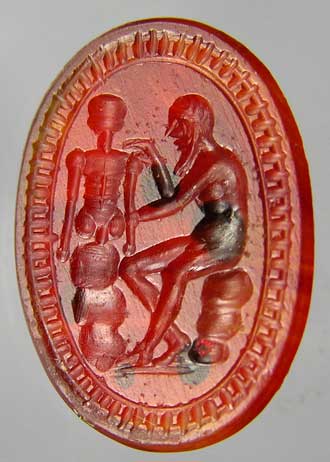
Prometheus fabricating the first human, ancient carnelian gem. Courtesy of Claudia Wagner.
Editor: Judi Pajo

Gods and Robots
Adrienne Mayor Gods and Robots: Myths, Machines, and Ancient Dreams of Technology Princeton University Press 304 pages, 6 1/8 x 9 1/4 inches ISBN 978 0691183510
Available here →September 4, 2019
20190904-mayor-adrienne-on-book-gods-robots-myths-machines-ancient-dreams-3-1
A close-up
The rest of this thread
.webp)
Josiah Ober
Adrienne Mayor
Adrienne Mayor is a research scholar in the Classics Department and History and Philosophy of Science Program, Stanford University. In 2018-19, she was a Berggruen Fellow, Center for Advanced Study in the Behavioral Sciences. She is the author of The Amazons: Lives and Legends of Warrior Women across the Ancient World; The First Fossil Hunters; Fossil Legends of the First Americans; Greek Fire, Poison Arrows, and Scorpion Bombs: Biological and Chemical Weapons in the Ancient World; a biography of Mithradates, The Poison King (National Book Award nonfiction finalist); and Gods and Robots.
Pull this thread
The idea of robots is ancient, and Hesiod's Talos, with inner workings and a power source, qualifies as one.
Know something the rest of us don't?
Most threads on Rorotoko begin with our invitation. Any thread can begin with a proposal: you write it with the same prompts every thread answers, and we review it.
Propose a thread →