
Sarah Cole
Inventing Tomorrow
If one were to open Inventing Tomorrow somewhere, where should that be? If you are drawn to the big story and to the argument with modernism, read the Introduction. The conclusion pans out to see Wells as, above all, a writer engaged in his own distinctive form of world writing. But the joy of Wells, as with all creative geniuses, is also in the details. One of my own primary intellectual formations has been as a reader of war literature, and I hope that those interested in war will be energized by the discussion of how Wells, in a life-time of bracing depictions of total war, recalibrated the place of the civilian, and hence adds to the robust rethinking of war’s voices that, boosted by the recent centenary of the First World War, is well underway in current scholarship. I have mentioned time and scale as major scholarly topics today, and my chapter on “Time” addresses these, arguing that Wells stands as one of the great philosophers of time in this period; no small claim given how robust the theorization of time was among modernists.
The history of science, and particularly of biology, animates the chapter “Biology,” as I follow Wells’s ambitious writing of life as a primary principle. Sparring with modernism, engaging with evolution as one of the crucial principles of life and death, moving in and out of science, in and out of fiction, Wells as life writer breaks out of expected categories and offers vivid insights into the place of the human in its many ecosystems. Considering biology, though, we find some of Wells’s least palatable qualities, his penchant for perfecting the polity, his attraction to some of the principles of eugenics. Wells is always both an exemplification and an exaggerator of his culture’s interests, desires, and fears, and when it came to the hothouse of late 19th and early 20th century science, Wells embarced both the beauty and the ugliness like no one else.
But I think my own favorite part of Inventing Tomorrow may be the reading of The Outline of History (1920)—one of the great books of interwar modern writing and a world bestseller. Thinking about The Outline in the context of time, and of Wells’s dramatic recalibrating of the writing of history in the 20th century, these segments open up aspects of literary culture that cut close to the modernist bone— and also depart forcefully. Wells the historian is an entirely unfamiliar character to us, and yet, one of the most recognizable to his contemporaries. We thus find ourselves looking squarely at the major disjunction at the heart of this book: the gulf between contemporary literary studies and the actual reading and imagining habits of one hundred years ago.
Writing this book has been the most exciting intellectual undertaking of my career so far, and also the most difficult. It was challenging for a few reasons— the need to construct my own methodology for reading and assessing Wells, as one example, and the sheer scale of his oeuvre as another— but the most pressing issue is that Wells can be as nasty as he is marvelous, as distressing as he is invigorating. Such is life, such is he: not only a flawed person, but a reminder of how motivating and progressive ideals can live in partnership with much that is ugly or misguided. Yet it was (and is) not my primary goal to judge Wells for his faults or critique him for failing to meet my own ethical standards. Rather I find myself profoundly energized by the imaginative universe that was Wells’s work, and I seek to follow those aspects of his thought that speak to my own ideals— of peace, say, or the need to protect the earth, or the ongoing belief that we can do better. I have never sought heroes or saints in those I study, and Wells is by any measure an unlikely entrant into sainthood. But it is my firm conviction that what Wells offers us in his enormous and stimulating body of work outweighs his shortcomings, opening up avenues for thought that, in some uncanny (indeed perhaps Wellsian) way, have been here all along, if one only knew to look for them. Reading his work has changed my view of just about everything I read; this is a great gift and I hope my own readers will be able to partake of this transformative energy.
If nothing else, I hope my book will send people to Wells, where they will think and judge for themselves about the meaning and value of his works. This is really an infinite trove, with works of every sort (see a brief list on the next page): from the explosive, brief science fiction of his early career, which remains famous and influential today; to his brilliant short stories; to his biting, often very funny social comedy; to the realist or social issue novels of the early century that combatively entered the debates of the moment; to the meditative essay novels of the 20s; to the big books in popular history and science that represented the height of Wells’s ambition to unite the world with concepts of a shared past and future; to his many genres of war and peace writing; to his own personal storytelling, which in a way encompasses all of these myriad works and culminates in his actual autobiography, another bestseller; and of course to film, those written by Wells himself, and the endless adaptations of his works that continue to emerge each year and to influence so many other productions.
Ultimately, it is the pleasure of discovery that stands out in reading Wells, how startling, jarring, interesting and reorienting these works can be.A few Wells books by genreScience Fiction: The Time Machine (1895), The Island of Doctor Moreau (1896), The War of the Worlds (1898), The Invisible Man (1897), The First Men in the Moon (1901), The Croquet Player (1936)Short Stories: The Country of the Blind (1904), The Door in the Wall (1906)Social Comedy: Kipps (1905), The History of Mr. Polly (1910)Novels around Social Issues: Ann Veronica (1910), The War in the Air (1908), Tono-Bungay (1909)Utopias: A Modern Utopia (1905), The Shape of Things to Come (1934)Essay Novels: The World of William Clissold (1926)Popular Disciplines: The Outline of History (1920)War Writings: The World Set Free (1914), The War that will End War (1914), Mr. Britling Sees it Through (1916), The Rights of Man (1940)Autobiography: Experiment in Autobiography (1934)Film: Things to Come (1936)
Editor: Judi Pajo
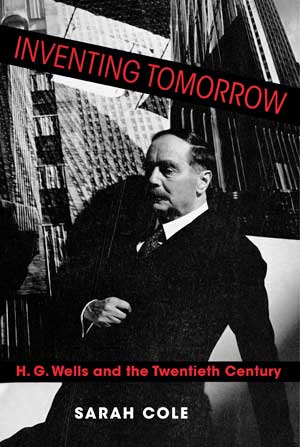
Inventing Tomorrow
Sarah Cole Inventing Tomorrow: H. G. Wells and the Twentieth Century Columbia University Press 392 pages, 6.5 x 9.5 inches ISBN 978 0231193122
Available here →February 26, 2020
20200226-cole-sarah-on-book-inventing-tomorrow-hg-wells-twentieth-century-3-1
A close-up
The rest of this thread

Sarah Cole
Sarah Cole is Parr Professor of English and Comparative Literature and Dean of Humanities at Columbia University. A specialist in literary modernism, she is the co-founder of the NYNJ Modernism Seminar and director of the Humanities War and Peace Initiative at Columbia. She is the author of three books, Inventing Tomorrow: H. G. Wells and the Twentieth Century (Columbia, 2019), At the Violet Hour: Modernism and Violence in England and Ireland (Oxford, Modernist Literature and Culture series, 2012) and Modernism, Male Friendship, and the First World War (Cambridge, 2003), and has published articles in journals such as PMLA, Modernism/modernity, Modernist Cultures, Modern Fiction Studies, and ELH, and in edited collections. She is the recipient of a Guggenheim Fellowship.
Pull this thread
Beginning the twentieth century with Wells rather than modernism yields a larger literary period, and Wells's supposed failings are strategies.
Know something the rest of us don't?
Most threads on Rorotoko begin with our invitation. Any thread can begin with a proposal: you write it with the same prompts every thread answers, and we review it.
Propose a thread →