
Brian A. Hatcher
Hinduism Before Reform
When it first dawned on me that Rammohun and Sahajanand were nearly exact contemporaries my immediate thought was: What a wonderful opportunity to bring into view the character and complexity of a short-lived moment in South Asian history. One of the things I try to do is to provide a sense for what is distinctive about the period from roughly 1750 to 1850. I refer to this as the early colonial period in order to stress that many of the developments we associate with “colonialism” in India are features of a world that only really began to emerge after the 1857 Rebellion. The early colonial period, though colonial had not yet become the British Raj. As such, when one looks at this earlier moment, one notices it is less rigidly structured by racist attitudes; that the actors on the ground, Indian and Briton, often inhabited shared spaces and enacted shared agendas. This is not to ignore the implementation of colonial legislation, the devastating economic policies of the East India Company, nor the fact of British supremacy; but it is to say that the early colonial moment was one in which a figure like Rammohun could articulate his leadership in relation to Indo-Persianate norms of learning and ethics while cultivating British connections to advance his religious agenda. Similarly, a figure like Sahajanand, who is often pictured as being aloof from British power, was in fact deliberate in his efforts to meet East India Company officials and open to theological discussions with Christians in the area.
Chapters like “Fluid Landscapes” work to bring these issues to light by sketching economic, political and religious life in early colonial Bengal and Gujarat. One has a chance to appreciate the agency of various actors like peasants, landholders, urban merchants, and nouveaux riches, not to mention the complex legacy of mendicant communities and devotional polities. Here the historiographical goal is to move beyond the still prevalent idea that eighteenth-century India was the site of economic decay and socio-political anarchy. One can easily appreciate how this trope has helped underwrite both imperialist and nationalist narratives of reform. Once one commits to looking anew at this period, one realizes that the era of Rammohun and Sahajanand was one of incredible fluidity and immense opportunity.
So here we are. Today Calcutta is known as Kolkata and the city is sprouting skyscrapers and mega-malls. The tenor of politics is changing too, as decades of Marxist leadership have given way to new electoral tensions. Some of the parties making headway in Bengal today would have been almost unimaginable in pre-liberalization Calcutta. The Hindu majoritarianism of the BJP is making striking inroads, and side by side with the gleaming skyscrapers one spots the distinctive spires of North Indian nagara temples. It seems as if the twain has finally met—Rammohun’s Calcutta must make room for the Swaminarayanis (see image).
For many, changes like this strike a dissonant chord. And I am not thinking only of the spiritual and cultural heirs of Rammohun. Scholars of religion in modern India are themselves confronted with the challenge of rethinking some of their most cherished teleologies around progress in Indian religion and public life. Hard questions arise. Does the rapid expansion of the Sampraday in the past few decades register the return of the repressed in modern religious life? If the modern comparative study of religion has tended to celebrate the sober Vedantic inclusivism inaugurated by Rammohun, how will our textbooks make sense of the current landscape, with its soaring temples and exuberant devotional communities? If we continue to tell the story of modern Hinduism in terms of the inevitable spread of progressive religion across South Asia, we paint ourselves into an interpretive corner. Not only do the terms of our comparisons fail, but we face the uncomfortable challenge of confronting the colonial genealogy of our own disciplinary tools. But this is a task we must undertake. Along the way we should strive to develop new analytical tools, such as the model of religious polity construction I offer—tools that will allow us to bring together for comparison what scholarly accounts have for so long kept asunder. In the present-day confluence (or collision) of Gujarat and Bengal we face the challenge of assessing anew the place of religion in 21st century India.
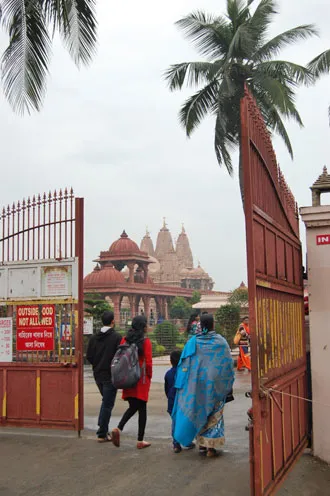
BAPS Swaminarayan Mandir, Kolkata Photo by Brian A. Hatcher, 2018.
Editor: Judi Pajo

Hinduism Before Reform
Brian A. Hatcher Hinduism Before Reform Harvard University Press 336 pages, 6 1/8 x 9 1/4 inches ISBN 978 0674988224
Available here →August 14, 2020
20200812-hatcher-brian-on-book-hinduism-before-reform-3-1
A close-up
The rest of this thread

Author self-portrait, West Bengal, 2017
Brian A. Hatcher
Brian A. Hatcher is Packard Professor of Theology in the Department of Religion at Tufts University. He is a scholar of religion in modern South Asia, with a special interest in colonial Bengal. He is the author of several monographs, including Idioms of Improvement: Vidyasagar and Cultural Encounter in Bengal (1996) and Bourgeois Hinduism, or the Faith of the Modern Vedantists (2008), and Hinduism Before Reform (2020). He has previously translated Ishvarchandra Vidyasagar’s Hindu Widow Marriage (2012).
Pull this thread
Rammohun Roy and Sahajanand Swami were religious lords heading new religious polities, and neither is best understood as a reformer.
Know something the rest of us don't?
Most threads on Rorotoko begin with our invitation. Any thread can begin with a proposal: you write it with the same prompts every thread answers, and we review it.
Propose a thread →