
Sujatha Fernandes
The Cuban Hustle
I hope readers who encounter the book at a bookstore might flip to the back of the book and see the ingenious and creative projects Cubans are creating, even in the dark days of the Trump era. We hear so much about the poverty and shortages induced by the tightened sanctions of the Trump administration, but I would also want people to see the ways that Cubans created a culture of resistance against the isolation that Trump tried to impose on the island. In recent years, a hairdressing school in the Old Havana barrio of Santo Ángel has involved its students in organizing activities for the children and seniors of the neighborhood. Young children filmmakers in the rural town of La Conchita made a documentary about the imminent closure of a factory that was the lifeblood of their community. Unlike their counterparts in the West, Cuban teenagers do not have unlimited apps and games to distract them on their phones; this group made their own fictional pieces and documentaries about the stories of their communities.
What many of these cultural phenomena share is a broader concern with social justice. Even when propelled by global markets and NGOs, cultures take on their own local shape, oriented toward the community. This is the legacy of the ideals, educational systems, and shared ethos of the Cuban Revolution. Cultural art forms have been closely connected with the development of social movements in Cuba. Afro-Cuban artists and hip hoppers used their art to raise issues of race and racism in Cuban society. They sowed the seeds for a rich array of racial justice organizations in the new millennium, such as ARAAC, the Red Barrial, and Alianza Unidad Racial. Artists have been at the forefront of social justice initiatives. Organizations such as Color Cubano and Magín have been led by artists, poets, and writers. The musician Silvio Rodríguez embarked on a tour of marginalized barrios to share his music with residents and understand their everyday struggles.
I hope that the book encourages people to see beyond Western media representations of Cuba. The media has been preoccupied with the idea of Cubans as trapped within a one-state autocracy, yearning for political and consumer freedoms unavailable to them. Cubans are generally depicted as repressed entrepreneurs: a world of small businesspeople, dissidents, bloggers, and others who want freedom of speech and freedom of commerce. The progression of Cuban society is its journey toward capitalism, the evolution of Cubans to become more like us. Such representations betray a deep failure to understand Cuba on its own terms.
There are many trajectories and models that loom large in the worldviews of Cubans, from the Black Radical tradition in the United States to the model of Chinese market socialism and the Pink Tide revolutions that swept Latin America. Some want more space to speak out critically or engage in commercial activities. And the growing presence of corporations such as Airbnb and Netflix is fostering new capitalist rationalities. But we must also understand the ways that consciousness and modes of being are deeply shaped by values of collectivism, egalitarianism, and voluntarism, derived from the socialist and post-independence past.
We hear much about Cuba’s transition. These essays depict a society in transition, but not necessarily one that is moving in a unilinear direction toward an embrace of capitalism. Rather, they reveal a range of utopic and liberatory visions that often take a socialist worldview as the horizon of the taken-for-granted, while also reflecting the multiple influences that have come to play a role in Cuban society from antiracist, anticapitalist, feminist, and LGBTQ movements to open-source information sharing, gamer culture, rock, hip hop, and reggae.
Editor: Judi Pajo
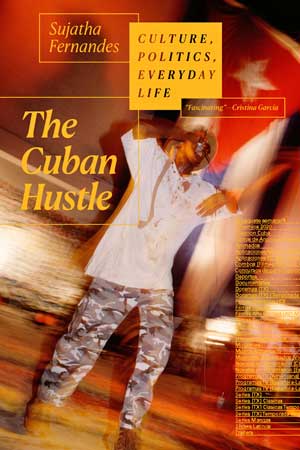
The Cuban Hustle
Sujatha Fernandes The Cuban Hustle: Culture, Politics, Everyday Life Duke University Press 184 pages, 6 x 9 inches ISBN 978 1478009641
Available here →January 13, 2021
20210113-fernandes-sujatha-on-book-cuban-hustle-culture-politics-everyday-3-1
A close-up
The rest of this thread

Sujatha Fernandes
Sujatha Fernandes is a writer and professor of political economy and sociology at the University of Sydney. Fernandes is the author of Cuba Represent! Cuban Arts, State Power, and the Making of New Revolutionary Cultures (Duke, 2006); Who Can Stop the Drums? Urban Social Movements in Chávez’s Venezuela (Duke, 2010); Close to the Edge: In Search of the Global Hip Hop Generation (Verso, 2011); and Curated Stories: The Uses and Misuses of Storytelling (Oxford, 2017). Her latest book entitled, The Cuban Hustle: Culture, Politics, Everyday Life (Duke, 2020), is featured in her Rorotoko interview.
Pull this thread
Scarcity produced Cuba's post-Soviet cultural flowering, and the hustle is an ethos of collective struggle rather than entrepreneurialism.
Know something the rest of us don't?
Most threads on Rorotoko begin with our invitation. Any thread can begin with a proposal: you write it with the same prompts every thread answers, and we review it.
Propose a thread →