
Charles Camic
Veblen
I would be happy if readers opened Chapter 3, “Beginnings.” Here I tell a family story and a national story as a prelude to the story of Thorstein Veblen as an intellectual innovator.
The family story is that of Thomas and Kari Veblen, a newly married couple who saw few opportunities in their native Norway. So, in 1847 they crossed the Atlantic in a whaling tub and made their way to the upper Midwest where, after a rough start, they built a prosperous farm, where they adopted the latest technological innovations.
Simultaneously, Thomas and Kari tended carefully to the schooling of their nine children, enrolling seven of them (including two daughters) in the preparatory program of a nearby college, where four of them then continued their studies into the college proper.
By a stroke of fortune, that college was Carleton College, named for a Boston brass manufacturer who in 1871 gifted the school with a million dollars (in today’s dollars), the largest sum given up to then to a Midwestern college. Spending wisely, the college soon boasted a cutting-edge curriculum in the natural sciences (which taught evolutionary theory with approval), the humanities, and the social sciences.
In the social sciences, Carleton established one of America’s first professorships in the subject of political economy, hiring for it the future giant of American (neoclassical) economics, John Bates Clark. Following Clark’s example, Veblen then decided to attend graduate school and, for this reason, to leave the farmlands to live in the industrializing cities of Baltimore and Chicago (with many destinations in between). The timing of this move coincided with the birth of graduate schools in the United States, which were then trumpeting their use of modern scientific methods to study the natural world and the social world, economic life in particular.
In microcosm, this saga was the drama of postbellum America: the Great Atlantic Migration, the agricultural settlement of the Midwest, the explosive takeoff of urbanization and industrialization, the transformation of higher education through capitalist philanthropy, and the celebration of scientific methods.
All of these epochal developments enveloped the family of Thomas and Kari Veblen and also buffeted the budding economist in their midst. In the third chapter of my book, the reader sees the nesting of these Russian dolls.
In addition to examining the social origin of Veblen’s ideas, my book analyzes their vital substance.
Here too Veblen departs from conventional wisdom, which portrays Veblen primarily as an iconoclastic satirist of America’s wealthy in The Theory of the Leisure Class. An iconoclast Veblen was, but mainly because he was also a professional economist involved in debates with classical and neoclassical economists over the distribution of wealth among different social classes.
Then, as now, the issue of wealth distribution was an explosive and divisive one on the national stage, where battles raged between Capital and Labor and their spokespersons. Whether Veblen would have written about the leisure class outside of this context is unlikely; for, as he knew, satires of the leisure class were by then commonplace. Veblen did not think he needed to add another one unless it had something more to offer.
And The Theory of the Leisure Class did just that. Here (and elsewhere) Veblen maintained that most academic economists, as well as many journalists and political commentators, thought about economic life in the wrong way. They viewed economies in static terms, presenting economic life as essentially the same in all times and places. Moreover, they viewed economies as made up of separate individuals, all of them acting out of self-interest. Today, we find many economists and pundits who still hold to these notions in updated forms.
But Veblen relentlessly criticized these views. He insisted that economic life is constantly changing, and that economies are structured differently in different places and times. Not only this, but in economic life there are no standalone individuals. Economic activities, such as production and consumption, are always shaped, said Veblen, by the evolving institutions that people are embedded in.
From this critical perspective, Veblen attacked prevailing theories of wealth distribution that posited that people with wealth earned it through their individual contributions to improving the process of economic production. To the contrary averred Veblen—where there is wealth, there is robbery: predatory behavior by powerful parasitic groups that contrive to get “something for nothing” via social institutions, which evolve to adjust to historical change by devising ever-new mechanisms for thievery.
Observing his own society, Veblen saw economic institutions as enabling the accumulation of vast fortunes for the predatory class as its members pursued private profit. But he then pivoted to groups with other motives. Writing, in despair, about the beleagured men and women who served the interests of community at large by devoting themselves to the design and functioning of the “machine process,” Veblen posed the paradox: “Why are large and increasing portions of the community penniless… Why do we … have hard times and unemployment in the midst of excellent resources, high efficiency and plenty of unmet wants?”
More than a century after Veblen penned this question, the paradox remains, giving alarming pertinence to his forceful analysis of the predatory stratagems of modern economic institutions.
Editor: Judi Pajo
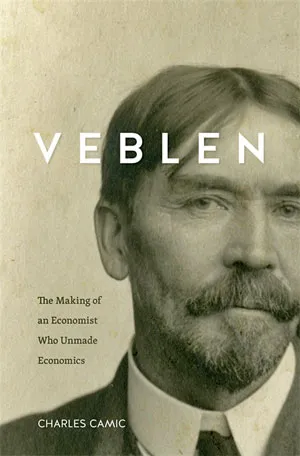
Veblen
Charles Camic Veblen: The Making of an Economist Who Unmade Economics Harvard University Press 504 pages, 6 1/8 x 9 1/4 inches ISBN 978 0674659728
Available here →June 23, 2021
20210623-camic-charles-on-book-veblen-making-economist-who-unmade-economics-3-1
A close-up
The rest of this thread

Charles Camic
Charles Camic is the Lorraine H. Morton Professor of Sociology and a member of the Science in Human Culture Program at Northwestern University. Formerly, he was the Martindale-Bascom Professor of Sociology at the University of Wisconsin-Madison. A specialist in sociological theory and the sociology of knowledge, he has written extensively on the development of late nineteenth- and early twentieth-century American and European social thought. He is the coeditor of Social Knowledge in the Making (University of Chicago Press, 2011).
Pull this thread
Veblen was an academic insider par excellence, and his heterodox economics came from that position rather than from marginality.
Know something the rest of us don't?
Most threads on Rorotoko begin with our invitation. Any thread can begin with a proposal: you write it with the same prompts every thread answers, and we review it.
Propose a thread →