
Garett Jones
The Culture Transplant
The Culture Transplant is about the fact that on average, immigrants never fully assimilate. Europeans who violently migrated to North America usually didn’t assimilate to Native American culture and levels of technology. Chinese migrants who migrated peacefully across Southeast Asia didn’t fully assimilate; instead, on average, they became “market dominant minorities.” Recent statistical work by my fellow macroeconomists shows that these aren’t outliers or exceptions. Instead, they illustrate a general rule: cultural and economic behaviors migrate and persist across the generations.
That’s looking across centuries after 1500 when humans ran a series of massive and often evil migration experiments, and economists have learned from those experiments. I should emphasize that isn’t a story about the benefits of geography: the richest parts of the Americas used to be closer to the equator (especially the Inca, but also the Aztec and Maya), but now they’re far from the equator.
That’s true both to the North (US, Canada) and the South (Argentina, Chile, Uruguay). Prosperity, by and large, went where the Europeans went in the Americas, and it lasted for centuries.
And it’s not like being close to the equator is an economic curse today: the richest country in Southeast Asia is almost on the equator itself: Singapore, with a majority population that’s of Chinese descent. So geography-based stories of prosperity are missing a lot, and they keep us from seeing the transformative power of migration to change the wealth of nations.
If you want to know how rich a nation is today, you’ll do a lot better job if you know the history of where a nation’s ancestors came from, rather than knowing the history of the land itself. Prosperity has deep roots, and those deep roots get transplanted when people migrate.
Editor: Judi Pajo
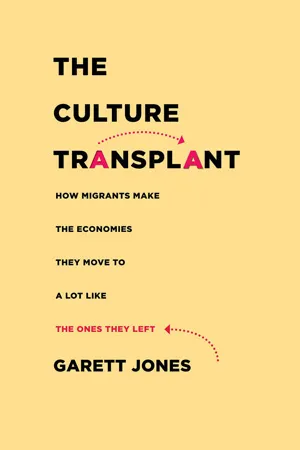
The Culture Transplant
Garett Jones The Culture Transplant: How Migrants Make the Economies They Move To a Lot Like the Ones They Left Stanford University Press 228 pages, 6 x 9 inches ISBN 9781503632943
Available here →September 14, 2023
20230913-jones-garett-on-book-culture-transplant-how-migrants-make-economies-they-move-to-a-lot-like-the-ones-they-left-1-1-1
In a nutshell
The rest of this thread

Garett Jones
Garett Jones is a macroeconomist at George Mason University renowned for his work on the interplay between IQ and national economic outcomes. He is the author of Hive Mind: How Your Nation’s IQ Matters So Much More Than Your Own (Stanford University Press), a book that explores the collective intelligence of societies. Jones combines elements of neoclassical macroeconomics and Chicago-school microeconomics to approach complex economic issues. Known for his interdisciplinary scholarship, he delves into the social sciences and philosophy, challenging conventional wisdom in empirical research.
Pull this thread
Immigrants on average never fully assimilate, their culture travels with them across generations.
Know something the rest of us don't?
Most threads on Rorotoko begin with our invitation. Any thread can begin with a proposal: you write it with the same prompts every thread answers, and we review it.
Propose a thread →