
Vladimir Kogan
No Adults Left Behind
I’ve been interested in education, and attending school board meetings, for more than half of my life. I began in high school when, as editor of my high school newspaper, I decided it was important to see what the local school board was doing. This was right after the federal No Child Left Behind Act was passed and I still remember a board meeting where everyone panicked about how they were going to achieve 100% proficiency in math and reading by 2014, as the law required. (Needless to say, that goal was never reached.)After college, I wrote for the Voice of San Diego, the first online-only, nonprofit journalism organization that focused on local issues. My beat was the San Diego Unified School District.
And over the past 10 years, I have worked with colleagues to collect the most comprehensive data on local school elections available, thanks to generous support from the Spencer Foundation.
Although I didn’t set out to write a book on education, eventually I saw too many important themes that no one was talking about. No one fully explained why the dysfunction and complaints that have been made about public education are essentially hardwired into how schools are governed. No one has pointed out that our system is effectively “gerrymandered” to serve mobilized and self-interested adults, even at the expense of students and their learning.
Education scholarship, I’m sad to say, is one of the biggest offenders. Many scholars seem to start with the premise that the current system is optimal and their job is to defend it. They use “democracy” as a trump card to criticize reforms that truly move the needle on academic achievement and attainment and transform kids’ lives for the better. Other academics focus on fringe theories—writing hundreds of pages of impenetrable prose about “neoliberalism” and other “isms”—that have almost nothing to do with the real world.
No Adult Left Behind, I hope, is an antidote to these pathologies. It brings together what we’ve learned in our research and provides a clear and compelling overview of what’s gone wrong and offers some modest ideas for how we can do better.
Curator: Bora Pajo
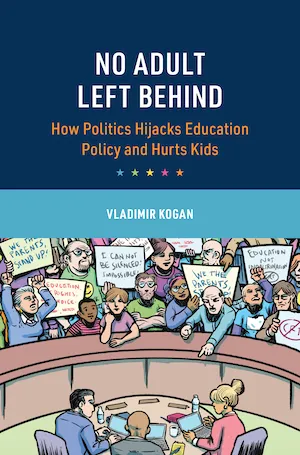
No Adults Left Behind
Vladimir Kogan No Adults Left Behind: How Politics Hijacks Education and Hurts Kids Cambridge University Press 328 pages, 6 x 9 inches, ISBN 978-1009606318
Available here →September 1, 2025
20250901-kogan-no-adult-left-behind
The wide angle
The rest of this thread

Vladimir Kogan
Vladimir Kogan is a professor of political science at the Ohio State University. His research focuses on the intersection of politics and public policy. Kogan’s work has been published in top scholarly journals, including American Political Science Review, American Journal of Political Science, Journal of Policy Analysis and Management, and Journal of Public Economics. He is the author of No Adult Left Behind: How Politics Hijacks Education Policy and Hurts Kids (Cambridge University Press, 2025).
Pull this thread
pulls againstpulls alongside
School dysfunction is hardwired into governance, because school boards answer to an electorate mostly without school-aged children.
Against AG · In research universities the best scholars make the best leaders, and a hospital should be led by a doctor. On: Institutional outcomes are produced by structural design rather than by the qualities of the individuals inside
Against AG · Organizational toxicity is a clinical condition that spreads like a contagion, and it is treatable. On: Institutional outcomes are produced by structural design rather than by the qualities of the individuals inside
Alongside LR · Iraq's antiquities were pillaged for structural reasons, and most of the people involved acted in good faith. On: Institutional outcomes are produced by structural design rather than by the qualities of the individuals inside
Alongside RB · The American trial is dying from the bureaucratic and market structures around it, and that death is not inevitable. On: Institutional outcomes are produced by structural design rather than by the qualities of the individuals inside
Alongside DD · A large dealer bank fails by one mechanical sequence, a run by its overnight lenders, whatever caused the crisis. On: Institutional outcomes are produced by structural design rather than by the qualities of the individuals inside
Alongside AP · The immigration courts' dysfunction is structural, improvised in 1940 out of fear of a Nazi fifth column that never existed. On: Institutional outcomes are produced by structural design rather than by the qualities of the individuals inside
Nearby GP · Reischauer got Japan right, and deep language and area knowledge inside government prevents wars.
Know something the rest of us don't?
Most threads on Rorotoko begin with our invitation. Any thread can begin with a proposal: you write it with the same prompts every thread answers, and we review it.
Propose a thread →