
Olivier Alexandre
Tech
My previous research was about the French movie industry. In 2014, Netflix was just arriving in France, opening up an office in Paris. I got funding for studying this company located in Los Gatos, CA, which seemed to be having a very different mentality, way to produce and distribute content, than the LA studios. A lot of professionals were worrying about this new player coming after the French and European markets. I’ve been invited as a visiting scholar at Stanford University, mostly thanks to Professor Fred Turner (I owe him a lot!), who wrote a wonderful book about how and why Silicon Valley and North Cal counterculture have intersected since the 1960s. At that point, I thought I had done the toughest part of this endeavor, i.e., get to the Valley. I was all wrong. With my work on Netflix, I’ve found out pretty quickly the meaning of what I call the tech transparency paradox. In tech, everything seems open and actionable: code, companies, people. Which it’s true… but if and only if you have something to bet, to sell, or to buy. It could be your coding skills, your network, your money, your intel about a special market or country, or even your entertainment and leisure activities (from climbing to clubbing). But I had nothing to sell or to buy. So Netflix doors stayed closed to me. I had to take another path. My own path, which was, I realized it later, the path of many in tech. In Silicon Valley, most people come from a different state in the US, and half of them are born in a country other than the US. Mainly from India, China, or Europe. They came pretty young, are mostly male, and are college boys. They are away from their friends, families, cultures, churches, institutions, news, and politics of their country. So basically, they have nothing else to do than go to work. And coming from sometimes quite a social constraint milieu, they fall in love with this pretty tolerant, tech enthusiast, and risk-taking environment, which is Silicon Valley. At least, it’s the way they described it. And they put everything in it. But working in Silicon Valley is not just a way to get paid or get successful. Quite the opposite, actually. Because most of the time, people fail, products crash, ideas are thrown into the trash, and are just copied. If techies are ok with that, it’s because working in tech means to them learning something new. Of course, people in tech chase success. But this success doesn't necessarily mean making a fortune. It means learning something and making things work: their code, product, company, and for some of them also their body, society, and the government. Sometimes with as determination as naivety. For doing that, they think they have to measure everything, based on information, continuously improving the system, whatever the system is, and even if the system is not really a system. Because the body, or a society, is quite different from a computer system.
Curator: Rachel Althof
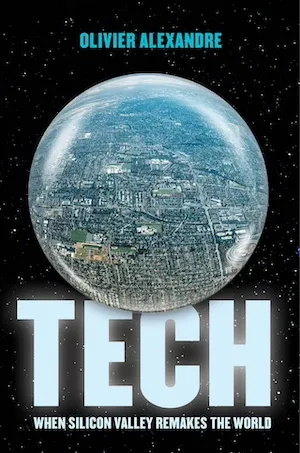
Tech
Olivier Alexandre Tech: When Silicon Valley Remakes the World University of California Press 344 pages, 6 x 9 inches, ISBN 9780520413740
Available here →October 23, 2025
20251023-alexandre-olivier-tech-when-silicon-valley-remakes-the-world-2
The wide angle
The rest of this thread

Hermance Triay
Olivier Alexandre
Olivier Alexandre is a CNRS research fellow and deputy director of the Centre Internet et Société. He has been a visiting scholar at Northwestern University and Stanford University. His work focuses on tech and culture. His publications include Tech. When Silicon Valley Remakes the World (California University Press, 2025).
Pull this thread
In Silicon Valley the star is the system, not any entrepreneur or company.
Know something the rest of us don't?
Most threads on Rorotoko begin with our invitation. Any thread can begin with a proposal: you write it with the same prompts every thread answers, and we review it.
Propose a thread →