
Aditi Sahasrabuddhe
Bankers' Trust
For anyone who stumbled upon Bankers’ Trust in a bookstore, I’d hope they’d open to the first pages, where the story begins not with numbers or charts, but with people. The book opens in the midst of a major policy intervention in 1920s Belgium. We see excerpts from a letter by the Bank of England Governor, describing the new Belgian governor—not his economic skills, but his character. Norman wrote,
I wished you could have met M. Franck—so very different from Hautain. A gentleman, who speaks English beautifully + opens his heart as well as his head + states his case firmly without being dogmatic . . . and Flemish instead of Latin!
The central question quickly emerges: why do some moments of panic lead to cooperation, while others end in collapse? Norman’s colleague Benjamin Strong in New York sums it up:
The point he makes about cooperation is, of course, of the greatest significance, but raises the question which you and I have discussed so frequently and fully. How can such a situation as the present one be met by any scheme or device, automatic or mechanical? Must it not be dealt with by this species of management and cooperation such as we have been attempting to give it, and if so, must not people generally trust someone, and therefore, does it not resolve itself to the simple question, 'Do they trust us?’
From that close-up view, the book invites readers into the world of central banks as human institutions, where trust and personal familiarity often matter as much as policy or power. Historical episodes—from the interwar years to 2008—show how relationships built quietly over time determine whose economies are rescued and whose are left to struggle.
The 1920s illustrate a fragile system stabilized by a small circle of trusted bankers. The Great Depression shows how that order can collapse when key figures die or governments change. In the 1960s Bretton Woods era, personal ties still guided cooperation, despite growing institutions. And 2008 demonstrates that even today, the global system depends on a few individuals willing to trust one another when everything begins to fall apart.
These are not stories of faceless markets, but of people navigating uncertainty, risk, and connection. The pages I’d hope readers see first reveal the fragile web of trust—the human glue holding a system that seems mechanical.As I wrote Bankers’ Trust, upon doing the research for this book, a goal of mine was to put a face on financial governance. Too often, the global economy is described as a machine, driven by rules, charts, and abstract institutions. But the history I uncovered tells a different story: the stability—or fragility—of the system often comes down to the judgment, trust, and relationships of a handful of people.
From the interwar years to the 2008 crisis, small networks of central bankers coordinated lifelines, navigated uncertainty, and, in many cases, prevented collapse. The Great Depression, by contrast, shows how quickly things can unravel when those connections break—through sudden death, leadership turnover, or political turmoil.I hope readers walk away seeing financial governance as a profoundly human enterprise. These historical lessons have pressing implications today. In a world of rising uncertainty, geopolitical tensions, and increasingly isolationist policies, formal institutions matter, but personal networks among technocrats still hold enormous sway.
Our system continues to rely on a few trusted actors who can bridge divides, coordinate responses, and act decisively across borders—especially when governments hesitate or retreat from cooperation.Ultimately, my aim is for readers to recognize both the power and fragility of these networks. Understanding the personal dimension of crisis management shows why trust, credibility, and relationships remain central to global stability. It reminds us that maintaining connections—between people as well as institutions—is not just a historical curiosity, but a necessity in today’s interconnected, unpredictable world. Bankers’ Trust is, above all, a story of how much depends on human judgment, and a call to appreciate the people who quietly keep the global system from falling apart, while nevertheless doing so with an eye to the underlying tensions of this fragile system with norms of democratic governance.
Curator: Rachel Althof
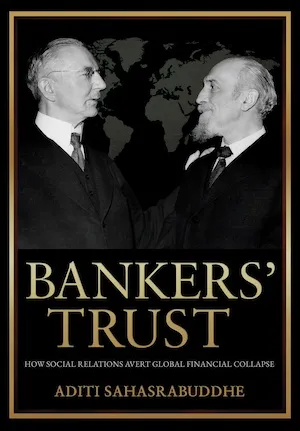
Bankers' Trust
Aditi Sahasrabuddhe Bankers' Trust: How Social Relations Avert Global Financial Collapse Cornell University Press 246 pages, 6 x 9 inches, ISBN 978-1501782589
Available here →January 16, 2026
20251215-sahasrabuddhe-aditi-on-bankers-trust-how-social-relations-avert-global-financial-collapse-3
A close-up
The rest of this thread

Aditi Sahasrabuddhe
Aditi Sahasrabuddhe is an Assistant Professor of Political Science at Brown University, specializing in international political economy—geopolitics, global governance, and the politics of international finance and central banking. Her book, Bankers’ Trust (Cornell, 2025), argues that trust among central bankers helps avert global crises. Aditi's research appears in International Studies Quarterly, International Theory, Review of International Organizations, and Review of International Political Economy, with commentary in the Financial Times, H-Diplo, The Washington Post’s Monkey Cage, and Phenomenal World.
Pull this thread
Emergency swap lines between central banks depend more on personal trust than on treaties, rules or state power.
Know something the rest of us don't?
Most threads on Rorotoko begin with our invitation. Any thread can begin with a proposal: you write it with the same prompts every thread answers, and we review it.
Propose a thread →