
Jonathan Kahn
The Uses of Diversity
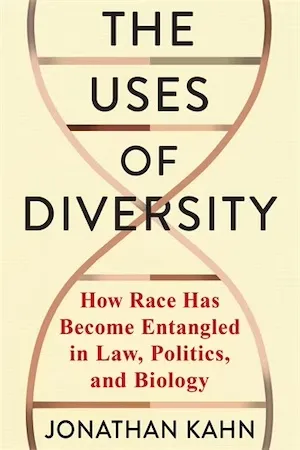
This book examines the blurring of the distinction between social understandings of race and biological understandings of genetic variation, showing how the concept of diversity is often deployed in ways that threaten to biologize race or undermine efforts to address racial injustice. Diversity serves a special role here precisely because, over the past half century, it has become a central organizing concept not only in the domains of law, politics and commerce but also in the biological sciences, particularly genomics. Thus, even as diversity has played an increasingly prominent role in contentious political debates of recent years, it has emerged as a powerful trope framing major undertakings in the biosciences, where, for example, enlisting “diverse” cohorts of research subjects into massive genomic data bases has become a sine qua non of realizing the “promise” of personalized medicine.
Diversity has become a prime site for slippage across these domains, with actors from all areas using the concept of diversity in ways that blur the distinction between social understandings of race and biological understandings of genetic variation. These entanglements change and manifest differently over time and in different contexts. Managing these entanglements is critical to ensuring that the concept of diversity is not deployed in ways that produce misguided constructions of race as biological or misapply understandings of biology in legal or political contexts to undermine initiatives intended to understand and address persistent issues of racial inequality and injustice.
The story begins at Harvard in the early 1970s, where eminent population geneticist and Marxist professor Richard Lewontin was laying the foundations for modern understandings of human genetic diversity with his foundational article showing that there was more genetic variation within what we call “races” than between them. Meanwhile, a few blocks away at the Law School, scion of the East Coast establishment, Archibald Cox, having recently been fired by President Nixon from his post as Special Watergate Prosecutor, was working on a Supreme Court brief that would ultimately provide the basis for the articulation of modern legal conceptualizations of social diversity in the foundational case of Bakke v. Board of Regents of the University of California. Over the ensuing fifty-odd years we see these concepts engaged in a sort of dance around each other, sometimes being discussed in creative juxtaposition, other times becoming dangerously entangled. Bringing us up to the present moment, the book explores what lessons we may draw from this story while providing an epilogue with an extended case-study of the uses (and misuses) of diversity during the height of the COVID-19 pandemic.
Curator: Rachel Althof
The Uses of Diversity
Kahn, Jonathan The Uses of Diversity: How Race Has Become Entangled in Law, Politics, and Biology Columbia University Press, 432 Pages, 6 x 9 inches, ISBN:9780231220149
Available here →January 13, 2026
20260113-jonathan-kahn-uses-of-diversity-how-race-has-become-entangled-in-law-politics-and-biology-2
In a nutshell
The rest of this thread

Jonathan Kahn
Jonathan Kahn, JD, PhD is a Professor of Law and Biology at Northeastern University. His current research focuses on the intersections of law and biotechnology, with particular attention to how law intersects with scientific, clinical and commercial practice in producing legal understandings of race and racism in American society. He is also the author of Race in a Bottle: The Story of BiDil and Racialized Medicine in a Post-Genomic Age and Race on the Brain: What Implicit Bias Gets Wrong About the Struggle for Racial Justice.
Pull this thread
Great minds think differently.
Know something the rest of us don't?
Most threads on Rorotoko begin with our invitation. Any thread can begin with a proposal: you write it with the same prompts every thread answers, and we review it.
Propose a thread →