
James Jeffrey Binney
Entropy
Entropy is a concept that's almost as important as energy, but far less widely understood. The book explains how until the 1850s the two concepts were confused, and that a clear understanding of what entropy really is was reached only in 1947.
A French military engineer, Sadi Carnot, took he first step by thinking clearly about steam engines. For almost two decades his work was neglected, and then it impeded the efforts of an English brewer, James Joule, to establish the concept of energy. Eventually a couple of Germans and a Scotsman made energy and entropy into well defined structures. Over the next fifty years an Austrian and an American made the connection between entropy and disorder. The final step was taken by a mathematician at Bell Labs working on telecommunication protocols.
Today entropy is a hot topic in research into quantum information, black-hole physics and quantum field theory. Entropy is a measure of missing information and quantum systems tend to leak information to their environments through the phenomenon of entanglement. Quantum technologies are concerned with limiting this leakage.
A black hole sets an upper limit on the entropy any body can have. Black holes contain stupendous quantities of entropy, but their entropies don't increase with mass as rapidly as predicted by quantum field theory. Our current understanding of material reality is based on quantum field theory, so entropy is signalling a fundamental weakness in our understanding of the Universe.
Curator: Rachel Althof
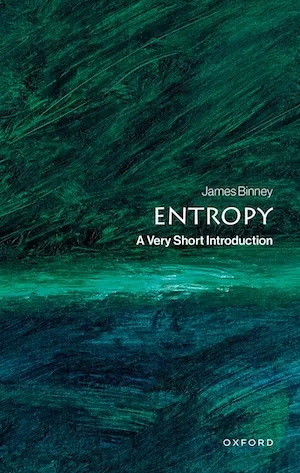
Entropy
James Binney (2025). Entropy: A Very Short Introduction, Oxford University Press, 128 pages, ISBN: 9780198901488
Available here →January 21, 2026
20260121-james-binney-entropy-very-short-introduction
In a nutshell
The rest of this thread

James Jeffrey Binney
James Jeffrey Binney is a British astrophysicist. He is a professor of physics at the University of Oxford and former head of the Sub-Department of Theoretical Physics as well as an Emeritus Fellow of Merton College. Binney is known principally for his work in theoretical galactic and extragalactic astrophysics, though he has made a number of contributions to areas outside of astrophysics as well. Binney has received a number of awards and honours for his work, including the Maxwell Prize of the Institute of Physics in 1986, the Brouwer Award of the American Astronomical Society in 2003, the Dirac Medal of the Institute of Physics in 2010, the Eddington Medal in 2013, and the Isaac Newton Medal in 2023. He has been a fellow of the Royal Astronomical Society since 1973, and was made a Fellow of the Royal Society and a fellow of the Institute of Physics, both in 2000. In 2022, Binney was elected an International Member of the US National Academy of Sciences.
Pull this thread
Energy's worth depends on its entropy.
Know something the rest of us don't?
Most threads on Rorotoko begin with our invitation. Any thread can begin with a proposal: you write it with the same prompts every thread answers, and we review it.
Propose a thread →