
In a nutshell
February 11, 2026
Who is Conscious?
Many people are fully convinced that animals such as dogs, cats and other mammals are conscious, but what about all the others? What about, birds, fish, octopuses and even crabs and insects? If a dog is conscious, what about the fleas living in the dog’s fur? Are they as conscious as the dog, or conscious but less so? And what does being conscious actually mean? Can we measure it? What sort of evidence can we look for to help us decide which animals might not just behave ‘as if’ they were conscious but actually feel pain, pleasure and suffering as we do?
This book is about how we might go about finding answers to these questions. Unlike many other books on the subject, it does not try to convince you that particular animals are or are not conscious or even of the virtues of a particular theory of consciousness. Rather, it’s aim is to look at the evidence that different people have put forward to claim that animals are conscious and to see how convincing it is. It is intended as a guidebook to the many different claims that have been made about which animals are conscious. My hope is that everyone – whatever their views on animals and how conscious they are – will find something of interest, something to make them think, something to help them answer the question ‘Who is conscious?’
Along the way, we look at many different sorts of evidence. The behaviour of animals themselves is a good starting point but has the problem that while we can observe what animals are doing, we can’t ask them what, if anything, they are feeling. Here research on human consciousness has the advantage. We can ask people what they are consciously experiencing at the same time as using brain scanning techniques to tell us what their brains are doing. The success of studies on human consciousness have, in turn, inspired new studies on animals. If there are some problems that humans can only solve when they are consciously aware of what they are doing and animals can also do these same tasks, does this show that the animals, too must be conscious?
We look at whether this is true or not. A looming problem is that most, if not all of the criteria that have so far been suggested for consciousness in animals can be met, or will plausibly soon be met, by machines. Computer can integrate information, self-monitor, handle motivational trade-offs and do many other things often held to be the ‘signatures’ of consciousness. Awareness of what computers can do provides a sanity check on over-hasty conclusions about animal consciousness.
The book concludes with some guiding rules for how to think clearly about animal consciousness.
Curator: Rachel Althof
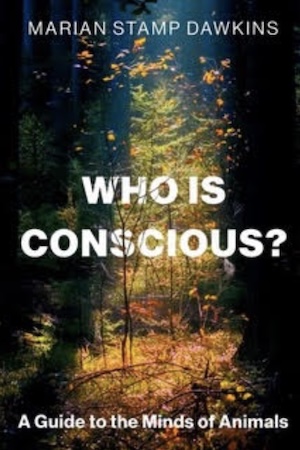
Who is Conscious?
Marian Stamp Dawkins, Who is Conscious? A Guide to the Minds of Animals, Oxford University Press, 160 pages, ISBN: 9780197818626
Get the book →February 11, 2026
202602211-dawkins-marian-who-is-conscious
The rest of this thread

Marian Stamp Dawkins
Marian Stamp Dawkins is Professor of Animal Behaviour in the Department of Biology at the University of Oxford and Fellow Emeritus in Biological Sciences at Somerville College, Oxford. Her research interests are in animal welfare, animal communication and animal consciousness and she has a particular concern with the process of putting welfare research into practice. She has worked on the welfare of poultry for many years in collaboration with various industrial partners in both Europe and the United States and is currently engaged in developing an automated system for assessing the welfare of broiler chickens using image processing of flock behaviour (OpticFlock). In addition to publishing many research papers, she is the author of Animal Suffering: the Science of Animal Welfare (1980), Through Our Eyes Only? The Search for Animal Consciousness (1993), Why Animals Matter: Animal Consciousness, Animal Welfare and Human Well-Being (2012) and The Science of Animal Welfare: Understanding What Animals Want (2021). With Aubrey Manning, she co-authored An Introduction to Animal Behaviour (4th-6th editions). Marian was awarded the Niko Tinbergen Medal by the Association for the Study of Animal Behaviour in 2009, the Robert Fraser Gordon Medal by the World Poultry Association 2011, the Universities Federation for Animal Welfare Medal in 2012 and the Patrick Moore Award by the RSPCA in 2014. In 2014 she was made a Fellow of the Royal Society and awarded the CBE for services to animal welfare. In 2018 she was made an Honorary Fellow of the Society for Applied Ethology. Her latest book, Who is Conscious? A Guide to the Minds of Animals is available as open access from Oxford University Press.
Feature your book
Publishing with a small press, or on your own?
A Sponsored Thread runs like every other thread on Rorotoko: three parts on three dates, the same editorial review, your own pages in the archive. Marked Sponsored. $199, paid only once accepted.
Feature your book →