
Robert C. Austin
Enver Hoxha
What’s unique about the Enver Hoxha: Twentieth-Century Tyrant is that we don’t actually have a decent scholarly biography of Enver Hoxha. There is some work—Blendi Fefziu has a book, which is fairly standard, even in its title, The Iron Fist of Albania—but our goal was different.
What’s unique about this book is that we wanted to situate it in a wider Europe, so that Albania doesn’t constantly appear as something exotic. The problem with studies of Albania, whether under Zog or under the communists, is that Albania is always treated as some kind of oddity. It’s quirky. The stories tend to lead with bunkers, isolation, and things like that. But that’s not the nuanced story.
The unique aspect of this book is that it situates dictatorship, tyranny, and totalitarianism in a broader framework so that people understand them better. The book was originally titled A Biography of a Balkan Tyrant, but in conversations with Artan Hoxha, my wonderful co-author, we changed the title. Artan asked a simple question: Why “Balkan”? It sounds simple, but it’s not. So we decided on Twentieth-Century Tyrant, because while there are differences for sure, the common features of these tyrannies are far more numerous than anything else.
That was what we wanted to do—place it within the context of modernity. We didn’t want to tell the standard story of bloodshed—then he killed him, then he killed that other person—because Blendi does a great job with that, and I’m not dismissing it. But we wanted to tell a different story, one that sheds light on some really uncovered aspects of that period and places them in a broader European perspective, so that Albania doesn’t appear as an anomaly in what was, in fact, a very similar communist world.
I’m not trying to be hard on anybody who’s written about Albania in the past—especially English-language authors, and I’m one of them—but I think we didn’t really get it. Part of that was the lack of access to archives. When I started the project, without that access, I found that I was writing the same story, just making it more accessible. That really disappointed me, and that’s where the project came into question as something I maybe shouldn’t do.
But bringing in an Albanian author—an Albanian specialist and a really top-notch Albanian historian—changed the landscape completely and made the book different. What’s unique about it is that it situates Hoxha in the wider realm of dictators. We’re also really good at telling Hoxha’s early life story and showing how much of it was a fluke—this role of contingency, where some things just happen.
Hoxha ends up first as a playboy living in France, an extremely good-looking, cosmopolitan guy who probably could have stayed there and made the rest of his life. Instead, there’s this fluke of coming back to Albania, running a tobacco shop, and then ending up as head of the Albanian Communist Party. Telling his story means also telling the story of his obsessions—particularly his obsession with modernity, which is not unique to Hoxha.
I’m constantly telling my students that the twentieth century is about these weird systems that are supposed to rush history. A colleague of mine, Marci Shore, talks to students about the Marxist idea that history has laws and that you can force them to go faster. You can rush history. Hoxha is one of those guys. If you understand your basic Lenin, Hoxha is a real Leninist: the idea that you can take a backward, illiterate country and turn it into something else. He tried. Eventually, he didn’t succeed. And like a lot of great dictators, he didn’t blame himself—he blamed his people, who were simply not up to the job, at least to him.
Ongoing thread. More from Robert C. Austin to follow.
Curator: Bora Pajo
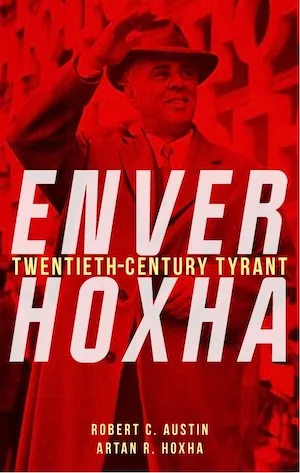
Enver Hoxha
Austin, Robert C., and Artan R. Hoxha. Enver Hoxha: Twentieth-Century Tyrant. London: Reaktion Books, 2026. ISBN 9781836391661
Available here →March 1, 2026
20260301-robert-austin-on-enver-hoxha
In a nutshell
The rest of this thread
.webp)
Robert C. Austin
Robert C. Austin is a specialist in East-Central and Southeastern Europe at the Centre for European and Eurasian Studies (CEES), University of Toronto. He has worked as a correspondent for Radio Free Europe/Radio Liberty, The Economist Group, and the Canadian Broadcasting Corporation, and has published in outlets including The Globe and Mail, The Toronto Star, Orbis, and East European Politics and Societies. Austin has lectured widely and held visiting appointments in Graz, Vienna, and Regensburg. His most recent book is Enver Hoxha: Biography of a Tyrant, co-authored with Artan Hoxha; earlier works include Royal Fraud (2024) and A History of Central Europe (2021). At CEES, he coordinates several European studies programs and has received multiple teaching awards, including the University of Toronto President’s Teaching Award (2025).
Pull this thread
pulls againstpulls alongside
Enver Hoxha is not explained by Albania, he was an ordinary twentieth-century tyrant of the Leninist type.
Against HR · Wounded Knee happened because control of the U.S. Senate hung on one contested South Dakota seat. On: Ideology explains state and collective violence
Against RI · The United States is an empire and aspired to be one from its origin, with liberty as its engine. On: National character is a real and durable explanatory factor
Against GE · No single agricultural model can be optimal, because the physical constraints agriculture works within vary in time and place. On: A model or method validated in one setting transfers usefully to others
Against TH · Ordinary crime control, not ideology, was one of the decisive steps to the Bolshevik totalitarian state. On: Ideology explains state and collective violence
Alongside DS · Dehumanization works because its victims are seen as human vermin, uncanny fusions of fellow human and subhuman creature. On: Ideology explains state and collective violence
Alongside JP · The Stalin cult was manufactured without a manufacturer, since no central cult institution could exist in a collectivist polity. On: National character is a real and durable explanatory factor
Alongside SM · Florida's tomato fields went from the country's worst labor conditions to among its best without a single new law. On: A model or method validated in one setting transfers usefully to others
Alongside AS · Russian revolutionary terrorism grew from deep Christian soil, and Zasulich's dream of martyrdom came from reading the Bible. On: Ideology explains state and collective violence
Know something the rest of us don't?
Most threads on Rorotoko begin with our invitation. Any thread can begin with a proposal: you write it with the same prompts every thread answers, and we read it.
Propose a thread →