
Thomas Dumm
Loneliness as a Way of Life
The book’s epilogue is entitled “Writing.” It is short, about seven pages, but it tells a story about a trip I made to Ethiopia with my older brother, right before I started to write the book itself. He wanted me to go with him in order to shake away the melancholy that had enveloped me in the two years since the death of my wife. That trip helped me tremendously, but not in the way I thought it would. Instead, it served to illuminate what a path through loneliness might be about, when we learn not to fight it, to try to overcome it, but to dwell with it, to appreciate its other elements.
I contrast my trip, which occurred during a period of political violence in Addis Ababa, with the admonition in Walden to practice what Thoreau called “home cosmography,” which I take to mean an exploration of how to be at home in the cosmos by writing about it.
For me, the epilogue ties things up in a way that isn’t too neat, but which nonetheless encourages further reflection by all of us on how we might move on in the face of loss. And again, like my editor’s intervention with the title, this epilogue is there not because of any special insight on my part, but because one of the readers of the manuscript suggested that writing about writing might be a good way to show why and how the book has been written in such a way.
My greatest hope for Loneliness as a Way of Life is that it helps someone who reads it to recognize his or her experience, not as being the same as mine, but as itself being something worth taking seriously. Too much writing, even writing about the self, is simply filled with self-help nostrums. Those books condescend to their readers. I ask my readers to descend to meet me. I take seriously both Emerson, who believed that a true self always descends from a higher place to be with others, and Socrates, who first used the idea of descending to the marketplace as a gesture through which democratic conversation might occur.
This book may be too ambitious, maybe too dense, it certainly is dark, but it sure doesn’t condescend to its readers. It doesn’t explicitly offer hope, but it does, I hope, illustrate a certain kind of turn in thinking and experiencing, a kind of writing of the self, that my readers may in turn be able to see as worth thinking about and trying to do.
Editor: Erind Pajo
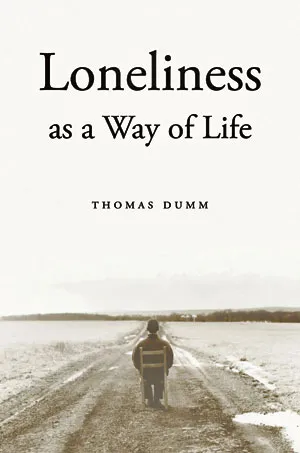
Loneliness as a Way of Life
Thomas Dumm Loneliness as a Way of Life Harvard University Press 208 pages, 5 1/2 x 8 1/4 ISBN: 978 0 674 03113 5
Available here →December 16, 2008
20081216-dumm-thomas-on-loneliness-as-a-way-of-life-3
A close-up
The rest of this thread

Jason Stemple
Thomas Dumm
Thomas Dumm is Professor of Political Science at Amherst College. Aside from Loneliness as a Way of Life, he is the author of four other books, and co-editor, with Frederick Dolan, of Rhetorical Republic (1993). He co-founded and served as first co-editor of the journal of contemporary political theory Theory & Event. He was awarded a John Simon Guggenheim Foundation fellowship in 2001.
Pull this thread
Loneliness is a way of life, rooted in a missing mother, that shapes political as well as personal possibility.
Know something the rest of us don't?
Most threads on Rorotoko begin with our invitation. Any thread can begin with a proposal: you write it with the same prompts every thread answers, and we review it.
Propose a thread →