
Thomas Dumm
Loneliness as a Way of Life
The title is an almost absurdly clear description of the book, but the truth is, until my editor suggested that title to me, I wasn’t quite sure that what I was trying to grasp was, in fact, a way of life. Loneliness as a Way of Life looks at three elements of the path of loneliness in modern life – how we buy and sell ourselves, which is to say, how we are possessed by our possessions, how we love, and how we grieve. I interweave philosophy, literature, and recollections of my own past experiences to try to understand more fully what it means to be lonely, what the history of modern loneliness is about.
I begin to set the scene for the book by writing about the tragedy of King Lear, how Cordelia and her dad, through some terrible misrecognitions of each other, each end up in a lonely place that we might recognize as being akin to our own modern place. I argue that a lot of loneliness has to do with the problem of the “missing mother.” And that thread, the problem of how we are unable to come to terms with that metaphorical (and sometimes literal) loss of mother, has, I argue, set the terms of our modern condition.
In successive chapters, I use new readings of some canonical works, primarily from American literature, to connect loneliness to a better understanding of the politics of experience. I am very interested in the politics of everyday life, and from a variety of angles I try to illuminate these different aspects of lonely existence. It adds up to an argument that loneliness is an element of the human condition that decidedly shapes the horizon of our possibilities, politically, socially, and existentially.
Because so much of this book is personal, I ask my readers to try to bring more of themselves to the reading of this book than they might otherwise do. I ask this in part as a plea, but also as a warning. This is not a happy book. In fact, at a roundtable concerning it recently in Boston, several of the commentators noted that they would be sitting and taking notes on the book in coffee bars, and suddenly find that they were crying.
I took that as a compliment. I tried to make this book have emotional, as well as intellectual, impact. Indeed, part of the point is to say that those two elements of how we comprehend the world are closer to each other than we usually appreciate.
Editor: Erind Pajo
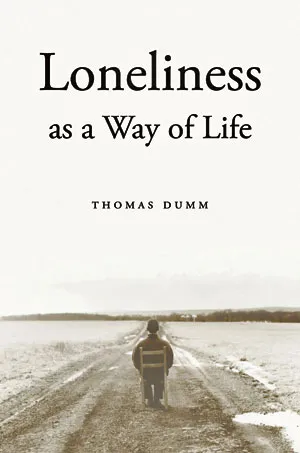
Loneliness as a Way of Life
Thomas Dumm Loneliness as a Way of Life Harvard University Press 208 pages, 5 1/2 x 8 1/4 ISBN: 978 0 674 03113 5
Available here →December 16, 2008
20081216-dumm-thomas-on-loneliness-as-a-way-of-life-1-1
In a nutshell
The rest of this thread

Jason Stemple
Thomas Dumm
Thomas Dumm is Professor of Political Science at Amherst College. Aside from Loneliness as a Way of Life, he is the author of four other books, and co-editor, with Frederick Dolan, of Rhetorical Republic (1993). He co-founded and served as first co-editor of the journal of contemporary political theory Theory & Event. He was awarded a John Simon Guggenheim Foundation fellowship in 2001.
Pull this thread
pulls againstpulls alongside
Loneliness is a way of life, rooted in a missing mother, that shapes political as well as personal possibility.
Against AR · Nihilism is true, because science cannot justify the morality nearly everyone accepts, and it is harmless. On: The researcher's own first-person experience is admissible evidence in scholarly argument
Against JK · Natural science cannot settle judicial, legislative or personal questions, because those rest on ethical premises evidence cannot supply. On: The researcher's own first-person experience is admissible evidence in scholarly argument
Alongside JP · The American Dream is the gateway drug, and meth cooking is a hyperbolic version of coming undone while pursuing it. On: The researcher's own first-person experience is admissible evidence in scholarly argument
Alongside JB · Film viewing is tactile contact between two bodies, the viewer's and the film's own. On: The researcher's own first-person experience is admissible evidence in scholarly argument
Alongside EM · All movement is already relational, composing spacetimes rather than crossing space. On: The researcher's own first-person experience is admissible evidence in scholarly argument
Alongside MK · Paintings of food are not still lifes, and Manet's fish conjure the corpses of the new Paris Morgue. On: The researcher's own first-person experience is admissible evidence in scholarly argument
Nearby PA · Conservatism has no fixed content, so the American Civil War was a fight between two conservatisms.
Know something the rest of us don't?
Most threads on Rorotoko begin with our invitation. Any thread can begin with a proposal: you write it with the same prompts every thread answers, and we review it.
Propose a thread →