
Dana Nelson
Bad for Democracy
As I finished my last book, National Manhood, a historical look at how notions of middle-class manhood and citizenship developed in the early United States, two movies about fictional presidents appeared—Contact and Airforce One. I ended up writing about those movies and their presidents in the conclusion to that book, because they offered so many interesting examples of some of the claims I was making about the symbolic work of the presidency in the early national period and focused some interesting questions about the perdurability of that symbolism.
That exercise made me think it might be worth examining the development of the presidency over time and its impact on democracy in the United States. I’ve been working on this project, off and on, for almost a decade. Whenever I gave talks on presidentialism, people from a range of political positions—liberal, conservative, libertarian, green—were excited about the arguments, and eager to see me develop them into a book.
Political scientists and presidential historians continue insisting that Presidents are weak—that they only have the power to “persuade,” following Richard Neustadt’s influential arguments, first published in 1960 and updated in 1980. Following this wisdom, political scientists and historians paid little attention to the campaigning of political conservatives and jurists on the subject of the unitary executive beginning in the early 1980s.
That theory’s proponents—many of them members of the Federalist Society—spent the 80s and 90s arguing for this theory in law journals and think tank forums. And their theory has been implemented and defended by every president since Reagan. Because George W. Bush was the first openly to advocate for the unitary executive, many have assumed that this is his unique perspective. It’s important to pay attention to its longer history; we need to understand this model of executive power—and its aims—if we mean to combat it.
Proponents argue that the Framers created a Unitary Executive in the Constitution, but that’s a claim that is very easy to rebuff. One delegate to the Constitutional Convention, New York’s Alexander Hamilton, may have personally preferred it. But other participants in the Convention resoundingly rejected his pro-monarchical views. In Madison’s notes on the Convention, it’s evident that the Framers worked to avoid giving the president any kind of power that might deliver the country to a system of one-man rule.
They did worry about the unpredictability of the legislature—the “democratic branch”—and that’s why they gave the President veto power. But they also admired the legislature as the best place for self-government to be conducted, and were very clear about their aims to construct what they termed a “Congressional government” where the “democratic branch”—the legislature—would be primary.
The Unitary Executive is in fact a controversial US corporate model where the CEO is also the Chair of the Board. It is a twentieth-century model for undivided corporate power. Since the Bush presidency, political scientists have begun training their attention directly on the rationales for and implications of the Unitary Executive—its proclivities toward unilateral powers and actions—and its hard turn away from the “weaker” skills of persuasion.
They are examining the expansion of executive unilateral powers, and debating about whether those powers really work to consolidate the president’s individual legacy. I’m less concerned with individual legacies in this book than in paying attention to what happens to our democracy in the face of those expanding unilateral powers.
While occasionally it’s a relief to turn our responsibilities over to someone else, I believe when most people think about it, they prefer to manage their responsibilities themselves. I think it is probably like that for democracy too. But here, the problem is that over time, citizens have been reconceived less as democratic actors then as passive consumers. For generations now, we have not been taught to think about democracy as our responsibility and our job, so it doesn’t really occur to most people that there’s anything they can do now—besides vote. This book urges us to rethink our democratic commitments and action plans before it’s literally too late.
Editor: Erind Pajo
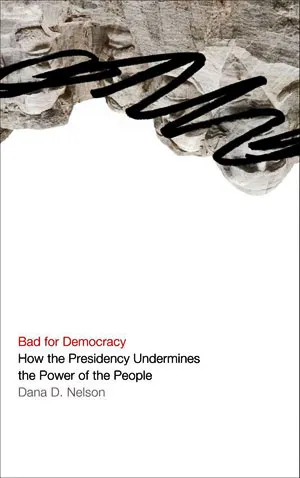
Bad for Democracy
Dana Nelson Bad for Democracy: How the Presidency Undermines the Power of the People University of Minnesota Press 256 pages, 6 x 9 inches ISBN: 978 0 8166 5677 6
Available here →December 23, 2008
20081223-nelson-dana-bad-for-democracy-how-presidency-undermines-power-peop-2
The wide angle
The rest of this thread

Daniel Dubois © Vanderbilt University
Dana Nelson
Dana D. Nelson is a professor of English and American studies at Vanderbilt University where she teaches classes in U.S. literature, history and culture, and courses that connect activism, volunteering, and citizenship. She has published numerous books, essay collections and articles on U.S. literature and the history of citizenship and democratic culture. Nelson lives in Nashville where she is involved in a program that helps incarcerated women develop better decision-making skills, and works for an innovative activist group fighting homelessness in the area.
Pull this thread
Our habit of putting the president at the center of democracy works against democracy.
Know something the rest of us don't?
Most threads on Rorotoko begin with our invitation. Any thread can begin with a proposal: you write it with the same prompts every thread answers, and we review it.
Propose a thread →