
Dana Nelson
Bad for Democracy
The-president-as-superhero myth promises all the democracy with none of the work. As such it teaches citizens to admire rule by strong individuals and to abjure the messy workings—disagreement, slow debates, compromise, bargaining—of actual democracy. This training works against our own abilities to navigate and wield democratic sovereignty. Subscribing to the search for a nationally redemptive hero every four years makes citizens feel less, and not more, powerful, and therefore all the more in need of a superhero presidential rescue.
Every cycle, we wind up disgusted by our leadership. And every presidential election leads citizens to the hope that this time, we’ve got it right. When we turn out to be wrong—again—about the salvific powers of this president, we helplessly put our hopes in the next. This boom-bust cycle of hope for the presidential rescue fuels the power of the presidency, if not always the actual power of individual presidents. It offers no such boon for the citizens, though.
Believing that the solution for democratic problems can only come through the intervention of a “great president,” we put our energy into exaggerated and mythical hopes for his agency, rather than investigating, investing in and cultivating our own. The presidency is not working for people’s sense of democratic involvement, agency, or fair play.
But many point out how few people currently vote, asking: how can you appeal to citizens to roll up their sleeves and do the hard work of revitalizing democracy when they can’t even be bothered to drive to the poll once every four years? I know the media and many political scientists are fond of pointing to low voter turnout as evidence that most citizens aren’t worthy of the powers of self-rule.
But I think that single number of non-voters conceals a lot of frustrated political engagement. While I don’t dispute that the roll of non-voters contains people who simply do not care about becoming involved in their political system—no matter what it is—I think there are lots of reasons people don’t vote. Sometimes they don’t vote precisely because they are so politically passionate, and disgusted by the way they can’t find anything close to their preferences represented in the political spectrum.
Some people don’t vote because they are in a political minority and their vote never “wins”—if you never see your interests represented after an election, it’s easy to just give up on voting, even though you still care about politics. I think if we worked to revitalize our formal political system and our political culture so that they did a better job at incentivizing more people to stay involved with the democratic “game”—for instance, we could use proportional representation for multi-body institutions like city councils, school boards, Congress, and preferential voting schemes for single-body offices like mayor, governor and president—people would feel that their vote wasn’t being wasted, they would see their views gaining some airtime in political bodies, and they might be more interested to try participating again.
Editor: Erind Pajo
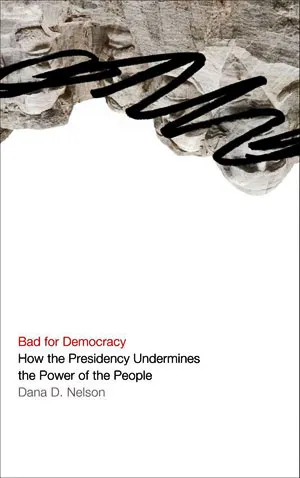
Bad for Democracy
Dana Nelson Bad for Democracy: How the Presidency Undermines the Power of the People University of Minnesota Press 256 pages, 6 x 9 inches ISBN: 978 0 8166 5677 6
Available here →December 23, 2008
20081223-nelson-dana-bad-for-democracy-how-presidency-undermines-power-peop-3
A close-up
The rest of this thread

Daniel Dubois © Vanderbilt University
Dana Nelson
Dana D. Nelson is a professor of English and American studies at Vanderbilt University where she teaches classes in U.S. literature, history and culture, and courses that connect activism, volunteering, and citizenship. She has published numerous books, essay collections and articles on U.S. literature and the history of citizenship and democratic culture. Nelson lives in Nashville where she is involved in a program that helps incarcerated women develop better decision-making skills, and works for an innovative activist group fighting homelessness in the area.
Pull this thread
Treating the presidential vote as the essence of democracy deskills citizens and strengthens the office whoever holds it.
Know something the rest of us don't?
Most threads on Rorotoko begin with our invitation. Any thread can begin with a proposal: you write it with the same prompts every thread answers, and we review it.
Propose a thread →