
Steven Stoll
The Great Delusion
The Great Delusion is about the unrealistic expectations we all have about what this tired and picked-over planet can provide us. It is about economic growth, the belief that a society can—even that it must—increase in wealth and population without end. I think that growth as we know it entered the American imagination in the 1840s—at the moment when an older faith in progress met the capacity to manufacture things on a large scale. Just watching steam engines made people think that energy and matter could be appropriated into this new system without end. Material progress became a popular expectation and, in time, a government policy. But the book is also a biography. I pin all of these ideas—and many more having to do with energy and resources—to an obscure German engineer named John Etzler. Why? Because Etzler took the most rational scientific ideas of his time and formulated them into a scheme to create infinite wealth with infinite energy for a world population that he hoped would top one trillion in his lifetime. The point is that if Etzler was crazy, so are we. Our presidential candidates might not use words like “infinite abundance,” but when they talk about prosperity without regard to planetary limits, when they promote growth as the cure for income inequality, they participate in the very same delusion.
Editor: Erind Pajo
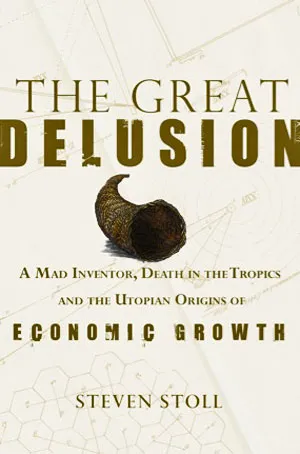
The Great Delusion
Steven Stoll The Great Delusion: A Mad Inventor, Death in the Tropics and the Utopian Origins of Economic Growth Hill and Wang 224 pages, 5 1/2 x 8 1/4 inches ISBN: 978 0 8090 9506 3
Available here →December 30, 2008
20081230-stoll-steven-great-delusion-inventor-tropics-utopian-economic-grow-1
In a nutshell
The rest of this thread

Michael Marsland
Steven Stoll
Steven Stoll is Visiting Associate Professor of History at Fordham University and the author of books on California, environmentalism, and the early republic. His writing has appeared in Harper’s, Lapham’s Quarterly, The New Haven Review, and most recently in The Chronicle of Higher Education in an essay on the Wall Street financial crisis.
Pull this thread
pulls againstpulls alongside
Endless growth in wealth and population is a utopian delusion that entered the American imagination in the 1840s.
Against JR · The Endangered Species Act works, and 262 species would have disappeared between 1973 and 2003 without it. On: Economic growth and environmental protection can advance together
Against GH · There is no inherent conflict between the economy and the environment, only four correctable defects in economic institutions. On: Economic growth and environmental protection can advance together
Alongside JE · Reducing unsustainability will never produce sustainability, which appears only when the whole system is working. On: Economic growth and environmental protection can advance together
Alongside JI · Conservation is one of the routes by which capitalist worldviews became environmental, not a defense of nature against capitalism. On: Economic growth and environmental protection can advance together
Alongside AE · Designing tools, objects and institutions designs ways of being, so market-driven design is a cause of the present crisis. On: Economic growth and environmental protection can advance together
Alongside MS · The sustainable transition and the just transition are one transition, or neither happens. On: Economic growth and environmental protection can advance together
Nearby ME · Economics explains why North and South clashed better than slavery does.
Know something the rest of us don't?
Most threads on Rorotoko begin with our invitation. Any thread can begin with a proposal: you write it with the same prompts every thread answers, and we read it.
Propose a thread →