
Harold S. Luft
Total Cure
I am an economist who spent the last 35 years in a medical school training a wide range of post-doctoral fellows and undertaking applied research in an interdisciplinary setting. My economics training inculcated a focus on the role of incentives and constraints. Collaborations with sociologists demonstrated the need to consider organizations. Political scientists highlighted the importance of governance issues and “rules of the game.” Anthropologists and ethicists illustrated how culture and values shape behavior.
Work with clinicians made real the uncertainties faced in day-to-day practice. Interactions with administrators led to an understanding of how risk needs to be managed. Quantitative tools demonstrated how large databases can be used to generate information and how crucial it is to focus on the quality of the data being recorded. All these lessons are reflected in the book.
The origins of this work can be traced to the early days of the HIV/AIDS epidemic in San Francisco. Some health plans were trying to avoid enrolling young men who lived in the largely gay Castro District for fear they might have an expensive disease. I heard these stories as a faculty representative on a committee overseeing the university’s health plans. But this was of more than academic or fiduciary interest—our staff members were dying and were being denied coverage because plans were afraid of the economic risks.
The challenge I decided to address was how to change payment incentives so health plans would take care of very sick people and even become so proficient at such care that they would gladly attract these patients. This led to years of work on risk adjustment techniques used both to assess quality and to adjust incentives. I eventually came to the conclusion that prospective risk adjustment, the approach generally favored by policy makers, would never be good enough to solve this problem. Instead, we need a mix of ongoing payments for the routine management of chronic disease (as HIV had now become) and separate bundled payments for the infrequent, but very expensive, hospitalizations.
The economics involved in this concept could be presented in a reasonable journal article.
That venue, however, would not allow me to address the concerns of real-world policy makers. For them and for others interested in a real system for change, I needed to describe how funds would flow among entities, how to facilitate income-based subsidies to address equity concerns, how to make this work in a practice environment dominated by physicians in solo and small group practices, and how to handle information in a confidential but transparent fashion. Describing an ideal world is (relatively) easy. I felt an obligation, however, to describe how we could plausibly evolve to a much improved system, taking into account the existing laws, political structures, and interest groups. A book, not an article, was necessary.
My policy proposal mixes universality and individualism. SecureChoice blends functions that require government with functions that are performed best by well-structured markets. In the context of the current political landscape, SecureChoice has important features that could be labeled as Red and others best seen as Blue. This may make it a target from both sides—or a reasonable compromise with the best of both worlds.
Editor: Erind Pajo
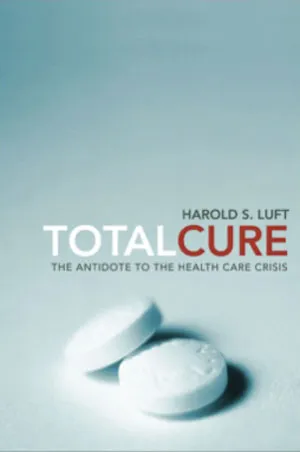
Total Cure
Harold Luft Total Cure: The Antidote to the Health Care Crisis Harvard University Press 298 pages, 5 1/2 x 8 1/4 inches ISBN 978 0674032101
Available here →January 6, 2009
20090106-luft-harold-total-cure-2
The wide angle
The rest of this thread

Richard Kite
Harold S. Luft
Harold S. Luft, Ph.D., is Director of the Palo Alto Medical Foundation Research Institute and Esselstyn Professor Emeritus of Health Policy and Health Economics and former Director of the Institute for Health Policy Studies, at the University of California, San Francisco. He received his degrees in economics from Harvard. His research has covered HMOs, hospital competition, volume, quality and outcomes of hospital care, risk assessment and risk adjustment, and health care reform. An elected member of the Institute of Medicine, he served on its Council, that of the Agency for Health Care Policy and Research, and of AcademyHealth. He was co-editor of Health Services Research.
Pull this thread
Extending access to a failing health system is not reform.
Know something the rest of us don't?
Most threads on Rorotoko begin with our invitation. Any thread can begin with a proposal: you write it with the same prompts every thread answers, and we review it.
Propose a thread →