
Kristen Whissel
Picturing American Modernity
Picturing American Modernity is about how the early American cinema represented major changes taking place in American society, politics, and culture in the early twentieth century, particularly changes that were related to the introduction and spread of new technologies. Each chapter analyzes a group of films that directly represented a major, (inter)national, mass-mediated “event”: the Spanish-American war, the Philippine-American war, the Pan-American Exposition, where President McKinley was shot, and the “white slavery” scandal, prostitution rings involving white, working-class women.
I focus on these events because for many turn-of-the-century Americans, they foregrounded the deeply ambivalent character of modern life and demanded new, self-conscious constructions of what it meant to be “American” in the machine age. That is to say, each made starkly visible both the possibilities associated with industrialization and expansion and its very serious perils.
Picturing American Modernity approaches these events as examples of the increasing incorporation of everyday life in the US into various forms of modern (i.e., high-tech) traffic. Each was linked to new forms of circulation and hence the increasing power and progress of the nation; yet all gave rise to high-tech crises that revealed various reasons to lament or resist the changes wrought by modern life.
My book shows how the silent cinema—itself a new technology—made each of these events visible, knowable, and pleasurable to moving picture audiences.
In the process, the book discusses how film itself developed during its first two decades and considers how the development of new genres and new types of narrative emerged out of the cinema’s own struggles to accommodate major changes in modern American life.
Throughout, I closely analyze non-fiction films made by the Edison Manufacturing Company shot in military camps before the Spanish-American War in 1898 or at the 1901 Pan-American Exposition in Buffalo, New York as well as fictional films directed by D.W. Griffith, George Loane Tucker, who directed the first American feature-length film, Traffic in Souls, and Lois Weber, the most prolific female American filmmaker of the silent era.
Editor: Erind Pajo
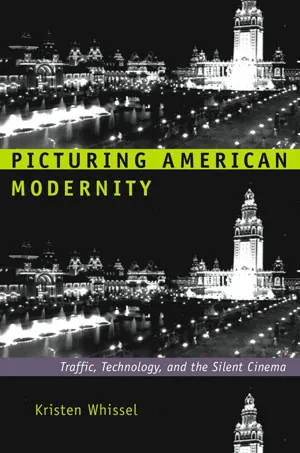
Picturing American Modernity
Kristen Whissel Picturing American Modernity: Traffic, Technology, and Silent Cinema Duke University Press 288 pages, 5 3/4 x 9 1/8 inches ISBN 978 0822342014 ISBN 978 0822341857
Available here →January 9, 2009
20090109-kristen-whissel-picturing-american-modernity-1
In a nutshell
The rest of this thread

Kristen Whissel
Kristen Whissel earned her Ph.D. from Brown University and is an Associate Professor in the Program in Film Studies at the University of California, Berkeley. She has published on silent American film in Screen, Camera Obscura, and Historical Journal for Film, Radio & Television, and serves on the Editorial Board for Film Criticism. She is currently writing a book on digital visual effects and contemporary film, part of which was published in Film Quarterly in an article titled, “Tales of Upward Mobility: the New Verticality and Digital Special Effects” (Summer 2006). In 2007, she won the Arts & Humanities Distinguished Teaching Award at U.C. Berkeley.
Pull this thread
Silent cinema developed its storytelling forms out of the effort to show modern networks of traffic.
Know something the rest of us don't?
Most threads on Rorotoko begin with our invitation. Any thread can begin with a proposal: you write it with the same prompts every thread answers, and we review it.
Propose a thread →