
Kristen Whissel
Picturing American Modernity
Sections of chapter 4 focus on the first feature film, Traffic in Souls (1913), short films by D.W. Griffith, such as The Lonedale Operator (1911), and Lois Weber’s amazing film Suspense (1912). These films are extraordinary because of the degree to which they are based on the premise that to participate in modern life is to be absorbed into traffic. This is true whether the films are set in a big city (Traffic in Souls), a suburb (Suspense) or a rural area (The Lonedale Operator). Moreover, they feature protagonists who unwittingly find themselves detoured into illegitimate or criminal forms of traffic without any notice.
They feature complex forms of rapid cross cutting to create suspense around their characters’ movements through city streets, along railway lines, across Ellis Island, and even along dirt roads. Each reveals how the concept of “traffic” with its multiple lines of movement across space and time helped organize strategies of film narration as production companies began to leave behind the short two-reel film that was the staple of most moving picture shows between 1908 and 1913 and began making more features (5 reels or more) after 1913.
This shift towards more features, in turn, had serious implications for moving picture audiences who were accustomed to thinking of themselves and experiencing moving pictures as part of the “traffic” that moved into and out of cinemas. Before the rise of the long feature, audiences could simply “drop in” to a moving picture show anytime they wanted and get up and leave at any point. As part of the customary “variety format” of a film program, audiences could expect to see four or five two-reelers and perhaps a slide show and a live musical performance.
Programs ran continuously without an official start or end time. If a patron came in midway through a film, they simply had to wait five or six minutes until a new film started and they could settle in and enjoy the program. Many moving picture patrons relied on this flexibility and stopped into moving picture shows while running errands, while on a lunch or dinner break, or on their way home from work. In short, it was very easy to walk in off the street, enjoy a few films, and leave whenever one wished while still feeling satisfied by the experience.
The exhibition of feature-length films forced patrons to adjust their movie-going habits. They now had to wait much longer for a film to start over again and sometimes had to sit through the second half of a movie without understanding at all what was going on before the film began again. This required some real adjustment on the part of audiences and exhibitors who often made their profit from the high turnover that the “variety program” of short films made possible. I make connections between representations of traffic in film, the use of the concept of traffic in creating new narrative patterns in longer films, and the effect on the “traffic” that moved through moving picture houses in the first section of Chapter 4.
I think Picturing American Modernity is particularly relevant to our current experiences and the events that the book covers will resonate with contemporary readers.
The book begins with a national crisis: the explosion that sunk the Battleship Maine, killing hundreds of American soldiers and starting two overseas wars, the Spanish-American War and the Philippine-American War, changed the way most Americans thought about themselves, their place in the world, and the various technologies and media that shape everyday life.
The early 2000s repeated this pattern with 9/11/01, the wars in Afghanistan and Iraq, and the experience of revolutionary technological change. Even the “white slavery scandal” echoes in current debates about, and representations of, new media, the internet, and the vulnerability of children or young women to sexual predators, real or mythological. Picturing American Modernity provides insight into a moment in American history, including film history, when what we consider “old” technologies were actually new, and it shows how the experiences, debates, and disasters that seem so new to us today are actually quite old.
Editor: Erind Pajo
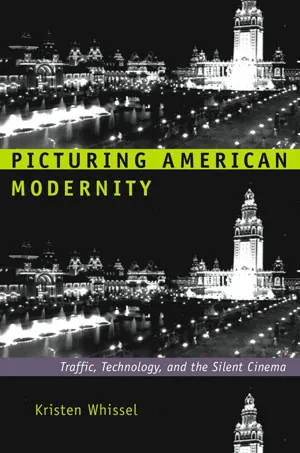
Picturing American Modernity
Kristen Whissel Picturing American Modernity: Traffic, Technology, and Silent Cinema Duke University Press 288 pages, 5 3/4 x 9 1/8 inches ISBN 978 0822342014ISBN 978 0822341857
Available here →January 9, 2009
20090109-kristen-whissel-picturing-american-modernity-3
A close-up
The rest of this thread

Kristen Whissel
Kristen Whissel earned her Ph.D. from Brown University and is an Associate Professor in the Program in Film Studies at the University of California, Berkeley. She has published on silent American film in Screen, Camera Obscura, and Historical Journal for Film, Radio & Television, and serves on the Editorial Board for Film Criticism. She is currently writing a book on digital visual effects and contemporary film, part of which was published in Film Quarterly in an article titled, “Tales of Upward Mobility: the New Verticality and Digital Special Effects” (Summer 2006). In 2007, she won the Arts & Humanities Distinguished Teaching Award at U.C. Berkeley.
Pull this thread
Silent cinema developed crosscutting and the feature film out of the effort to represent modern traffic.
Know something the rest of us don't?
Most threads on Rorotoko begin with our invitation. Any thread can begin with a proposal: you write it with the same prompts every thread answers, and we review it.
Propose a thread →