
Michael Long
Beautiful Monsters
All of the chapters are sectional in structure, with section headers. Anyone not interested in following the threads of the big arguments through the whole book might still find it interesting to read in bits. In fact, to fans of classic pop music or films, I’d suggest starting with the index and doing a title search for favorites.
The bookstore browser should probably dip into chapter 1. While it lays out the conceptual foundation for the arguments revisited throughout the book, chapter 1 also contains a bunch of illustrative case studies (including Jan and Dean, T. S. Eliot, Michael Jackson, Barry Manilow, Billy Joel, Kiss, Max Steiner, and others). They range in length from a few sentences to a couple of pages. And they are, I hope, both enlightening and entertaining.
Readers interested in the history of film music might particularly appreciate the chapter on musical Yiddishkeit (chapter 3). It is the most extended historical argument in the book, and draws popular literature into the mix along with music and film.
A serious reader interested in the humanities in general would find chapter 5, on “the dimensions of nostalgia,” especially interesting. This favorite of mine uses examples drawn from a broad spectrum of visual and musical materials to grapple with how artists have, in a literal sense, constructed nostalgia. That word has enjoyed tremendous circulation among academic writers, from literary critics to film scholars, for whom its implications rarely extend beyond those associated with “sentimental recall.” Here I analyze visual items ranging from pre-Raphaelite art to the films of Tarkovsky, and music from Baroque chorales to eighteenth-century clavichord music to psychedelic rock. I argue that nostalgia can serve as a surprisingly concrete and useful concept to frame specific modes of visual and acoustical expression. I suggest that art and media from all historical periods have employed these “formal” elements of nostalgia.
I hope Beautiful Monsters will be appreciated for what it is – an effort to provoke conversation rather than to promulgate unassailable arguments. I’d like to think that it could inspire others, especially students in the still-expanding fields of popular music and media history and criticism, to think and to write about how music works expressively in humane ways, even in the new digital environments. Whether or not my attempt to keep the tone light much of the time succeeds with all readers, I think it important to have made that effort. I’d say the same about what could be taken as my occasional “lapse” into sentiment. Both are gently but intentionally subversive.
I admit to finding our overspecialized and over-theorized humanistic academy, including the discipline of musicology, an unnecessarily grim place. (This was perfectly encapsulated for me in a recent blurb I read for a presentation at a humanities center, advertising the speaker’s theoretical plan to “render happiness complex and difficult.”)For me, the sound of the European musical past in twentieth-century American media was neither primarily the marker of a fraught cultural confrontation with normative culture, nor commentary upon or denial of normative culture. Media let the classic transform our ways of being expressive while the classic’s original implications were transformed right back, ensuring its continued viability in some form. For the future of our post-historical world of all musics, that was surely a good thing.
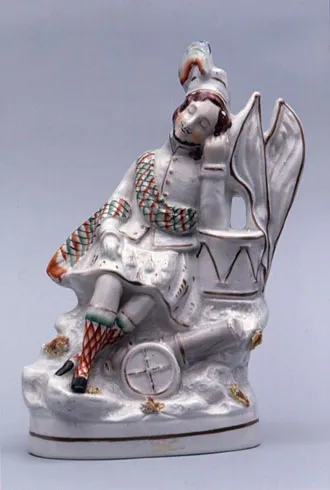
Musical nostalgia as ceramic artifact. Photo by Arnold Berlin.
Editor: Erind Pajo
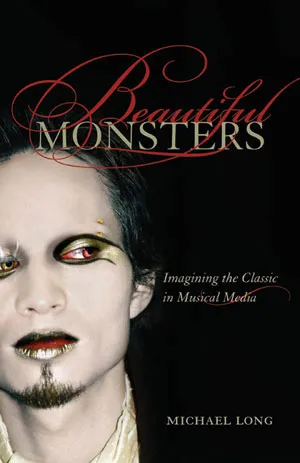
Beautiful Monsters
Michael Long Beautiful Monsters: Imagining the Classic in Musical Media University of California Press 328 pages, 6 x 9 inches ISBN 978 0520228979 ISBN 978 0520257207
Available here →February 20, 2009
20090220-long-michael-beautiful-monsters-imagining-classic-musical-media-3
A close-up
The rest of this thread
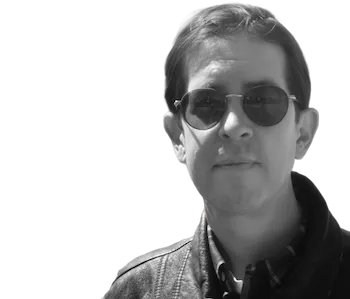
Michael Long
Michael Long is an associate professor of music at the University at Buffalo (State University of New York). A recipient of the American Musicological Society’s Alfred Einstein award and the SUNY Chancellor’s award for excellence in teaching, his essays on fourteenth- and fifteenth-century music have appeared in numerous collections and journals, including the Journal of the American Musicological Society and Early Music History. He has also served as an associate editor for the Journal of Film Music. Recent conference presentations on Kenneth Anger’s Fireworks and on Brokeback Mountain are part of his current book project exploring music, ritual, and the choreographic impulse in cinema.
Pull this thread
pulls againstpulls alongside
The European musical past survives in twentieth-century American media as a vernacular register ordinary listeners hear fluently.
Against CF · Americans today are not more mobile, less religious or more consumerist than their ancestors, and what changed is security. On: Nostalgia is a delusion about a past that never existed
Against BN · Western philosophy's refusal to teach Chinese, Indian and African thought is a lingering effect of Kantian racial theory. On: A canon records real artistic quality rather than the machinery that assembled it
Against MD · Nostalgia is itself a form of speculative fiction, and that is what links fandom to reactionary politics. On: Nostalgia is a delusion about a past that never existed
Against TS · What passes for art history is criticism in disguise, and there will be a period when Rembrandt is not admired. On: A canon records real artistic quality rather than the machinery that assembled it
Alongside RH · Humans are themselves a technology, and that technology is analog, so digital does not reflect what we are. On: Nostalgia is a delusion about a past that never existed
Alongside AW · Literature yields existential and sentient knowledge, and that, not any political payoff, is why we read it. On: A canon records real artistic quality rather than the machinery that assembled it
Alongside MS · Nostalgia is a category for critical reflection, and Shanghai's regional foodways are an objection to modernity. On: Nostalgia is a delusion about a past that never existed
Alongside BB · Nabokov is a maximalist, and readers who halt at modernist irony miss what makes him write. On: A canon records real artistic quality rather than the machinery that assembled it
Know something the rest of us don't?
Most threads on Rorotoko begin with our invitation. Any thread can begin with a proposal: you write it with the same prompts every thread answers, and we review it.
Propose a thread →