
Robert Engelman
More
More offers a new narrative of the human story that highlights the importance of intentional reproduction—wanting a child, and then having one—in the evolution of civilization and in light of our connections with nature. The book provides a history of contraception, natural as well as artificial, but also much more. Through much of our past, population growth has stimulated innovation and human development. But population growth can also give rise to natural resource scarcities and to hazardous social complexities. Today these are major threats on a global scale. Yet population growth could end soon, and for the best of reasons.
What women want, More argues, is more for their children, not so much more children. Or, put another way, women want what men don’t have to ask for: to be sexually active without inevitably risking pregnancy and childbirth. Indeed, throughout history, when women have timed their pregnancies to suit their lives and their environment, populations have grown slowly or not at all. When men control reproduction, by contrast, populations tend to grow unsustainably and sometimes catastrophically. Population growth itself, and nothing intrinsic in human genes or human nature, may well have produced a world that even today remains dominated by males.
More than any male triumph, it was women’s success in giving (and assisting) birth and parenting third and higher-order children to their own parenting age that guaranteed the human takeover of the planet’s landmasses. One of the book’s most novel arguments is that midwives began assisting births as soon as bipedalism began. Midwifery secured this risky evolutionary shift, spurred the development of language, and launched the development of contraception and abortion. Midwives became expert in both of these—at their own peril, especially during the European witchcraft hysteria.
Based on unambiguous differences between women and men (the former give birth; the latter on average have greater upper-body size and strength), More postulates that population growth explains much of the growing complexity and patriarchy of human social organization. The book calls for high-quality reproductive health services for all—including a wide variety of contraceptive options for both sexes and safe abortion—as the single most catalytic ingredient in building an environmentally and socially sustainable world.
Editor: Erind Pajo
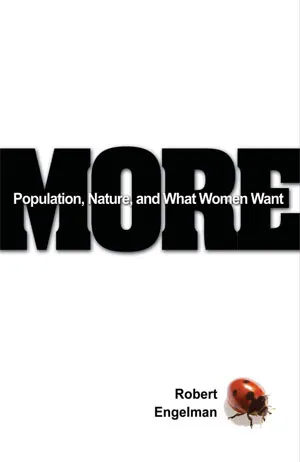
More
Robert Engelman More: Population, Nature, and What Women Want Island Press 320 pages, 6 x 9 inches ISBN 978 1597260190 ISBN 978 1597264433
Available here →March 27, 2009
20090327-engelman-robert-more-population-nature-what-women-want-1-1
In a nutshell
The rest of this thread

Tom Radcliffe
Robert Engelman
Robert Engelman is vice president for programs at Worldwatch Institute, a globally focused environmental research organization based in Washington, D.C., where he provides strategic direction for research and programs. Prior to joining Worldwatch, Engelman was vice president for research at Population Action International, a policy research and advocacy group in Washington. A former reporter for the Associated Press and several U.S. newspapers, Engelman holds a degree from Columbia University Graduate School of Journalism and has served on the faculty of Yale University as a visiting lecturer. He was founding secretary of the Society of Environmental Journalists and a founding board chair of the Center for a New American Dream, a non-governmental organization working to make U.S. consumption of energy and natural resources a sustainable model for the world. Engelman’s writing has appeared in scholarly and news media including Nature, The Washington Post, and The Wall Street Journal, and his book, More: Population, Nature, and What Women Want, was awarded the 2008 Global Media Award for Individual Reporting on Population by the Population Institute.
Pull this thread
Population growth ends when women decide the timing of their own births.
Know something the rest of us don't?
Most threads on Rorotoko begin with our invitation. Any thread can begin with a proposal: you write it with the same prompts every thread answers, and we review it.
Propose a thread →