
Laura A. Belmonte
Selling the American Way
Selling the American Way is about the ways that the U.S. government defined and disseminated official narratives about American society, politics, and culture during the early Cold War. Using radio programs, printed materials, films, music, art, sports, and other means, the State Department and the United States Information Agency sought to persuade foreign audiences to embrace democratic capitalism and to reject communism. The book’s first two chapters detail the political context in which these peacetime propaganda activities evolved and explain why it was often quite controversial for a democracy to engage in these activities. Heated political battles arose about the possible ramifications of targeting foreign audiences. Would, for example, a mass exodus of refugees from behind the Iron Curtain, overwhelm relief agencies? Would a U.S. propaganda offensive trigger a popular uprising that necessitated a U.S. military response? What, exactly, defined “the American way of life”? Such questions bedeviled U.S. policy makers, information experts, and congressional representatives.
The book’s next four chapters examine how specific elements of American life (politics, consumerism, labor, gender and the family, race, and religion among others) were “packaged” for international audiences. I discuss how the hallmarks of democracy and capitalism were explained and why and how foreign audiences did not passively or completely accept the visions of the United States being propagated abroad. Foreign audiences instead adopted a selective approach to what they admired and what they found hypocritical or contradictory. While it may have been easy for international audiences to grasp the allures of the U.S. standard of living as juxtaposed to life in a Soviet labor camp, they proved much more skeptical about declarations that the United States was actively combating racism and segregation.
Selling the American Way is written to be accessible to readers of serious nonfiction. I have intentionally avoided freighting the book with jargon and have situated these Cold War-era propaganda campaigns within the context of post-9/11 America. Accordingly, I hope the book will be both relevant and enjoyable.
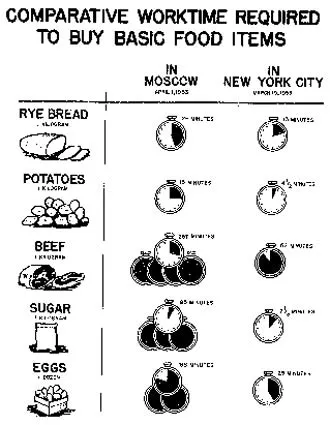
U.S. information experts drew stark contrasts between the lives of American and Soviet workers. This chart, prepared for the USIA by the U.S. Department of Labor, explained purchasing power in terms average people could understand. (Photo courtesy of National Archives; appears in the book on page 130.)
Editor: Erind Pajo

Selling the American Way
Laura A. Belmonte Selling the American Way: U.S. Propaganda and the Cold War University of Pennsylvania Press 272 pages, 6 x 9 inches ISBN 978 0812240825
Available here →April 14, 2009
20090414-belmonte-laura-selling-american-way-us-propaganda-cold-war-1-1
In a nutshell
The rest of this thread

Laura A. Belmonte
Laura A. Belmonte is Associate Professor of History and Director of American Studies at Oklahoma State University. She received her doctorate at the University of Virginia. In addition to Selling the American Way, she has published Speaking of America, a two-volume anthology of primary sources spanning U.S. history from the settlement era to the present. Her reviews have appeared in a variety of journals including the American Historical Review, the Journal of American History, and The Journal of Cold War Studies.
Pull this thread
No propaganda survives a country contradicting its own values.
Know something the rest of us don't?
Most threads on Rorotoko begin with our invitation. Any thread can begin with a proposal: you write it with the same prompts every thread answers, and we review it.
Propose a thread →