
Laura A. Belmonte
Selling the American Way
Start with the introduction to see how and why I situate the early Cold War propaganda campaigns into a post-9/11 context. I think anyone who has noted contemporary discussions about American “soft power” and the occasionally bombastic rhetoric about people hating “our freedoms” will be intrigued by the ways that the early Cold War informs these more recent trends. I also believe people concerned about the U.S. role in the world will be interested in learning more about how scholars are now approaching the study of U.S. foreign relations.
If the reader survives the introduction, then I’d direct him or her to one of the four “topical” chapters addressing how features of American life were explained and received. Each chapter is filled with wonderful tidbits about how U.S. policy makers made things as diverse as refrigerators, Sears’ catalogues, Monopoly games, jazz, and voting booths tools in their effort to persuade foreigners to emulate “the American way of life.” We also see how, time and time again, international audiences, honed in on weaknesses in U.S. society, forcing U.S. information experts not only to revise their tactics and materials, but also to reevaluate their understandings of what it means to be “American.”
There are some fascinating vignettes that demonstrate these trends. Depictions of race relations were particularly tricky. For example, at the American National Exhibition in Moscow in July 1959 (site of the famous “kitchen debate” between Richard Nixon and Nikita Khrushchev), U.S. information experts originally included an interracial couple in a bridal show designed to highlight American fashion and family mores. But, when foreign journalists saw a preview of the show and lambasted USIA for its unrealistic reflection of racial realities, U.S. officials replaced the couple with a white bride and groom. International audiences aware of lynchings, the furor attending the integration of public schools, and U.S. laws precluding interracial marriage were justifiably very skeptical about propagandists’ assertions that America was making great strides toward racial equality.
But, at the same time, the unpredictability of audience reactions also flummoxed communist propagandists. Over 3 million Soviets attended the Moscow exhibition. Neither years of anti-capitalist rhetoric nor limited exposure to non-communist life prevented these visitors from quickly grasping the attractions of American consumerism – literally. People stole books, toys, even frozen food samples, in their eagerness to have tangible reminders of the bounties of “decadent capitalism.”
I hope that Selling the American Way will prompt readers to be more attuned to how U.S. policy makers explain and have explained our nation and its international role to the world – and that we as informed citizens then demand that they address the often yawning gap between who we say we are and how we actually act in the global realm. Propaganda, public diplomacy, information, soft power – whatever euphemism one chooses – cannot alone ensure U.S. national security. But it most definitely can – and has – contributed to a better understanding among the world’s peoples, an objective I believe is more important than ever.
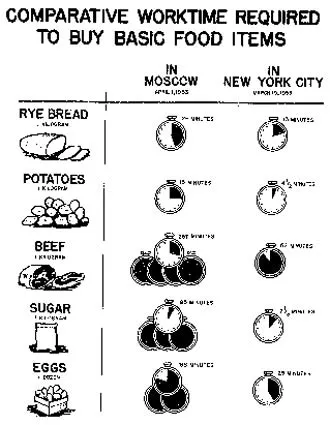
U.S. information experts drew stark contrasts between the lives of American and Soviet workers. This chart, prepared for the USIA by the U.S. Department of Labor, explained purchasing power in terms average people could understand. (Photo courtesy of National Archives; appears in the book on page 130.)
Editor: Erind Pajo

Selling the American Way
Laura A. Belmonte Selling the American Way: U. S. Propaganda and the Cold War University of Pennsylvania Press 272 pages, 6 x 9 inches ISBN 978 0812240825
Available here →April 14, 2009
20090414-belmonte-laura-selling-american-way-us-propaganda-cold-war-3
A close-up
The rest of this thread

Laura A. Belmonte
Laura A. Belmonte is Associate Professor of History and Director of American Studies at Oklahoma State University. She received her doctorate at the University of Virginia. In addition to Selling the American Way, she has published Speaking of America, a two-volume anthology of primary sources spanning U.S. history from the settlement era to the present. Her reviews have appeared in a variety of journals including the American Historical Review, the Journal of American History, and The Journal of Cold War Studies.
Pull this thread
Foreign audiences rejected US Cold War propaganda wherever American conduct contradicted it, forcing USIA to rethink what American meant.
Know something the rest of us don't?
Most threads on Rorotoko begin with our invitation. Any thread can begin with a proposal: you write it with the same prompts every thread answers, and we review it.
Propose a thread →