
Susanne Freidberg
Fresh
The chapter on eggs shows how and why refrigeration used to be controversial, which these days many people will find hard to imagine. It also contains a good story about the ironic consequences of consumer demand for genuine freshness. I don’t want to give away the punch line, but it starts from the basic fact that the egg used to be a highly seasonal “crop.” Who knew? I certainly didn’t before I wrote this book. An egg can also under certain conditions last a really long time, which made it an attractive commodity to the early 20th century cold storage industry. The problem with the egg, of course, is that it’s impossible to tell a fresh one from a stale one just by looking at it. This led to all kinds of marketplace deception and resulting controversies. These faded once more-or-less fresh eggs were available year-round—the chapter also tells how that happened—but not without a cost to both consumer and producer (namely the hen).
My book offers no rules about what to eat or buy. Many, many books already do that. In fact one of the bigger points of writing the book was to show how faith in such rules—about what’s really fresh or natural or healthy—has often blinded us (as consumers) to the larger causes of the problems we hope to solve by buying and eating the right foods. The current enthusiasm for local food is an example of this, I think. It’s not hard to see why local food is appealing at many levels; I find it appealing myself. It’s nice to think that buying this food might help local economies, preserve farmland and the environment more generally. It’s reassuring to know where one’s food comes from and who grows it, especially given all the recent scares related to “global” food. But if everybody’s going to have access to decent food, fresh and otherwise, we aren’t going to get there just by shopping at the farmers’ market. For many readers this might be an obvious point. Yet it still seems worth making, given that we are so besieged by messages telling us that the route to happiness and a better world runs through the market. I don’t buy it.
Editor: Erind Pajo
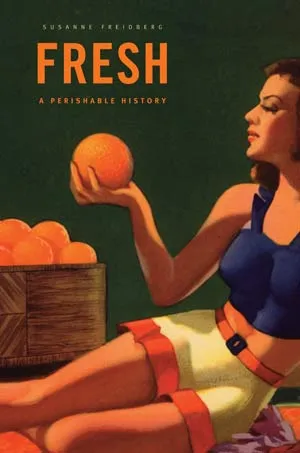
Fresh
Susanne Freidberg Fresh: A Perishable History Belknap Press 378 pages, 5 1/2 x 8 1/4 inches ISBN 978 0674032910
Available here →April 17, 2009
20090417-freidberg-susanne-fresh-perishable-history-3
A close-up
The rest of this thread

Marilyn Humphries
Susanne Freidberg
Susanne Freidberg is Associate Professor of Geography at Dartmouth College. Besides Fresh and her previous book, French Beans and Food Scares (Oxford, 2004), she has published articles in numerous journals and opinion pieces in the Washington Post and the New York Times. She has received fellowships from the National Science Foundation, the Radcliffe Institute for Advanced Studies, the American Council for Learned Societies, and the Mellon Foundation.
Pull this thread
Refrigeration broke the link between food quality and time, season and place, which is why it was bitterly opposed.
Know something the rest of us don't?
Most threads on Rorotoko begin with our invitation. Any thread can begin with a proposal: you write it with the same prompts every thread answers, and we review it.
Propose a thread →